
Set Your Deep Cleaning Frequency for Homes, Rentals & Small Businesses

Most homes need a professional deep clean on a regular basis, and homes with kids, pets, or allergy concerns often need one more frequently to keep buildup under control. If you’re already on a recurring standard cleaning plan, you can usually stretch to a single annual deep clean because the buildup that triggers most deep cleans never gets the chance to settle in.
TL;DR:
- Homes with high traffic, pets, or allergy concerns typically benefit from deep cleaning every two to three months, rather than annually.
- Kitchens, bathrooms, and carpets require more frequent deep cleaning—every three to six months—due to grease, moisture, and grime buildup.
- Standard cleaning routines significantly reduce the need for multiple deep cleans each year, often limiting it to only once annually.
- Deep cleaning schedules should be reassessed whenever household conditions change, such as the addition of pets, renovation, or new allergies.
- Professional services offer instant estimates, customizable recurring plans, and targeted deep cleaning for event-driven needs to fit varying schedules.
Table of Contents
- What is the right deep cleaning frequency for your home?
- What factors should change your deep cleaning schedule?
- Which rooms need deep cleaning most often?
- How do you schedule and budget for a deep clean?
- How can a professional deep clean fit your schedule?
- What the research gets right about deep cleaning frequency
- Ready to book your next deep clean?
- Sources
What is the right deep cleaning frequency for your home?
The honest answer depends on how your home lives, not just how it looks. Experts generally recommend one to two deep cleans a year for the average household, with frequent visits for homes with more traffic, fur, or allergy sensitivity. Here’s how that breaks down into buckets you can actually plan around.
- Annual — low-traffic homes, no pets, no kids, tidy habits year-round.
- Biannual (every 6 months) — the default for most families, matching the 3 to 6 month window many pros recommend.
- Quarterly (every 2 to 3 months) — pet owners, families with young kids, or anyone managing allergies or asthma.
- Every 2 to 3 months — Airbnb hosts and small offices with constant turnover.
- Event-driven — before hosting, after renovation, or during a move, regardless of your normal cadence.
Picture four households to see how this plays out:
- The low-maintenance couple: one deep clean each spring, standard cleanings biweekly in between.
- The busy family of four: quarterly deep cleans, with a standard clean every one to two weeks covering the gaps.
- The allergy household: deep clean every 8 to 10 weeks, focused heavily on vents, carpets, and bedding.
- The Airbnb host: a deep clean roughly every quarter layered on top of a thorough cleaning after every guest checkout.
A recurring standard cleaning plan changes this math more than most people expect. Capital Clean Care notes that well-maintained homes on a regular cleaning schedule often only need one true deep clean a year, since routine visits absorb the daily grime that would otherwise pile up into a bigger job.
What factors should change your deep cleaning schedule?
The baseline is a starting point, not a rule. Several variables push your ideal deep cleaning frequency up or down, and knowing which ones apply to you turns a generic schedule into one that actually fits your life.
- Household size and traffic: more people, more guests, more mess. A home hosting weekly gatherings needs deep cleaning more often than one occupied by a single remote worker.
- Pets: shedding, dander, and tracked-in dirt accelerate buildup in carpets and upholstery fast.
- Allergies and asthma: homes with these concerns often benefit from a deep clean every two to three months to keep indoor allergen load down.
- Local environment: high pollen counts, humidity, and poor ventilation all speed up dust and mold buildup. Keeping air-purifying houseplants around can ease the load between visits, though it’s no substitute for a scheduled clean.
- Routine cleaning quality: a thorough weekly wipe-down of counters and floors buys you real time before the next deep clean is due.
Pro Tip: If you can’t remember the last time someone moved the refrigerator or cleaned inside the oven, that’s usually a more reliable trigger than the calendar. Three months without a thorough clean in a busy home is a reasonable line in the sand.
Which rooms need deep cleaning most often?
Not every room ages at the same rate, and treating your whole house as one uniform task is where a lot of cleaning schedules go wrong. Deep cleans exist to catch buildup in the places routine visits skip — behind the fridge, inside the oven, along baseboards, inside window tracks. Grease, moisture, and grime don’t accumulate evenly across a floor plan.
- Kitchens and bathrooms: grease, moisture, and bacteria build up fastest here. Plan for a deep clean every 3 to 6 months even in low-traffic homes.
- Entryways and living rooms: tracked-in dirt and daily use call for quarterly attention in busy households.
- Bedrooms and guest rooms: one to two deep cleans a year is usually enough unless allergies or pets raise the cadence.
- Carpets, upholstery, and vents: these are specialist tasks. Typical deep-clean scopes include carpet extraction and scrubbing grout when pets or allergy concerns push the frequency higher. Interior doors and trim also deserve the right cleaning method for their finish to avoid dulling paint over repeated cleanings.
A room-by-room checklist makes it easier to track which spaces you’ve actually covered instead of guessing.
How do you schedule and budget for a deep clean?
Seasonal triggers work well for most households. Spring and fall resets, plus cleanups before hosting, moving, or wrapping up a renovation, give you a natural rhythm to build around instead of relying on memory alone.
Here’s a simple way to approach the actual booking:
- Estimate the time: a full deep clean typically runs longer than a standard visit, with size, scope, and add-ons like oven interiors or carpet extraction stretching the time and cost range.
- Prep the space: clear counters, secure pets, and flag any problem areas before the crew arrives.
- Decide what to DIY: quick spot fixes are fine between visits, but grout, vents, and appliance interiors are worth leaving to professionals.
- Consider a recurring plan: pairing a recurring standard clean with one annual deep clean is often more efficient than booking frequent standalone deep cleans.
Rule of thumb: if it’s been three months since a thorough clean in a high-activity home, it’s time to book one.
How can a professional deep clean fit your schedule?
Matching the right cadence to your home is only half the job. Getting it booked without the back-and-forth is the other half, and that’s where a dedicated deep cleaning service earns its keep.
Professional deep cleaning services can address the schedule gaps this guide covers:
- Instant online estimate — see a real price in about 60 seconds instead of waiting on a callback, which makes it easy to compare a one-off deep clean against a recurring plan.
- Recurring cleaning plans — weekly, biweekly, or monthly visits that can lower how often a full deep clean is even necessary.
- Move-in/move-out and Airbnb turnover cleaning — built for the event-driven triggers this guide flags.
- Complimentary fridge cleaning — included with every visit, covering one of the most commonly neglected deep-clean tasks.
What the research gets right about deep cleaning frequency
Most guidance on this topic treats frequency like a fixed rule: twice a year, no exceptions. That’s a reasonable starting point, but it undersells how much a recurring standard cleaning plan changes the calculation. A household maintaining weekly or biweekly visits is solving a fundamentally different problem than one that cleans sporadically and calls a deep clean only when things feel out of control.
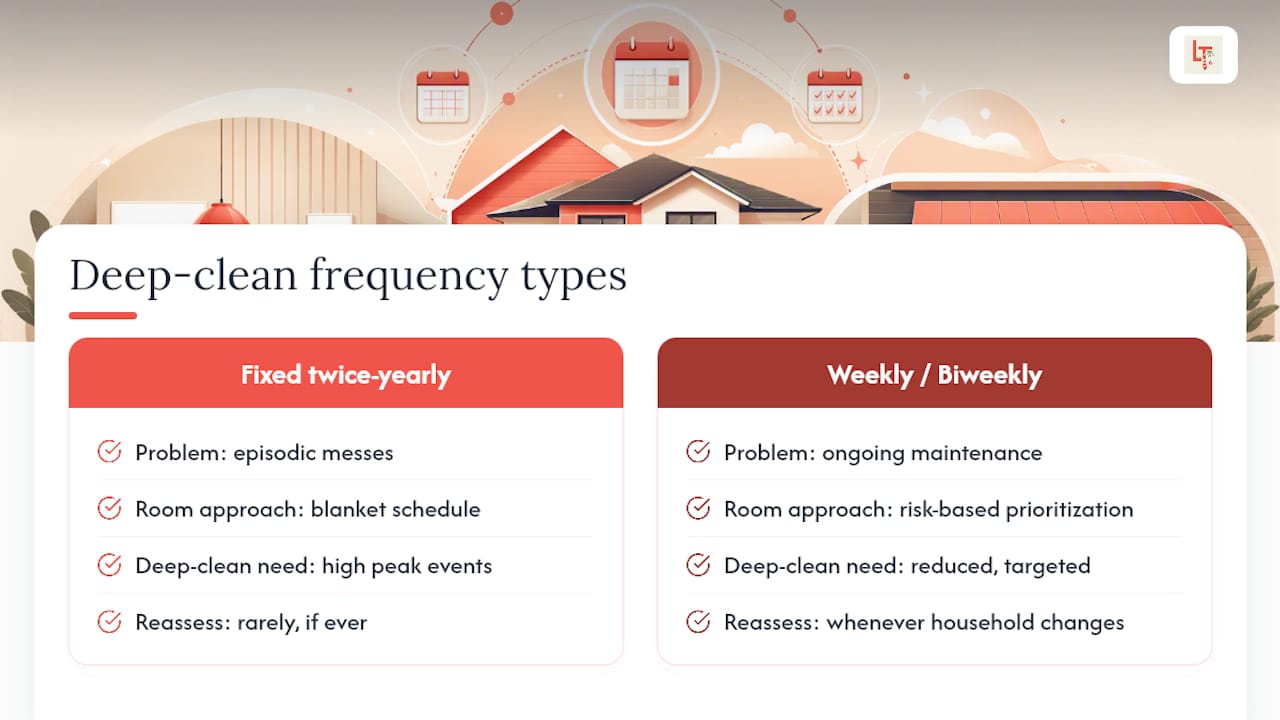
The bigger blind spot in most advice is treating every room the same. Kitchens and bathrooms accumulate grease and bacteria far faster than a guest bedroom, yet plenty of schedules apply one blanket frequency to the whole house. Prioritizing rooms by actual risk, not square footage, is the detail that separates a genuinely useful cleaning schedule from a generic checklist.
If you take one thing from this guide, let it be this: don’t set your frequency once and forget it. Reassess it whenever your household changes, whether that’s a new pet, a new baby, or a renovation that just kicked dust into every vent in the house.
— Luka
Ready to book your next deep clean?
Limpiezatropical is the practical alternative to guessing at your own schedule or piecing together DIY fixes room by room. Instead of researching cadences and hoping you got it right, you get a real price in about 60 seconds through the instant estimate tool, then a local team that handles the scope you actually need, including a complimentary fridge clean on every visit.
Booking is straightforward: get your instant estimate, confirm the scope with the team, pick a date, and do a quick walk-through prep beforehand, clearing counters and securing pets. A first deep-clean visit typically covers the tasks routine cleanings skip, with add-ons like carpet extraction or oven interiors available if your space needs them. If your household fits a recurring rhythm better than a one-off visit, the cleaning plans page breaks down weekly, biweekly, and monthly options. Ready to see your number? Head to the deep cleaning services page and get your estimate now.
Sources
The frequency ranges and room priorities in this guide draw on practical guidance from Care.com, Angi, and Katie Cleans. For a task-by-task breakdown you can follow at home, the deep cleaning checklist and the deep clean vs. standard clean comparison go deeper into scope and timing.