
Hourly vs Flat Rate Cleaning: Which Pricing Model Wins?

For recurring, predictable home cleanings, flat-rate pricing is usually the smarter pick. For one-off jobs or homes nobody’s cleaned professionally before, hourly protects both you and the cleaner from a bad guess.
That’s the short version. The nuance is what actually matters here: industry practitioner guidance points to a hybrid approach most experienced cleaning businesses already use. They bill hourly for the first deep clean, since nobody knows yet how bad the grout is or how many boxes are stacked in the hallway. Once that baseline is set, they switch you to a flat rate for maintenance visits. Hourly rates run $40–$55 per hour in many markets, while Limpiezatropical’s instant estimate tool gives you a flat-rate figure in about 60 seconds, no callback required.
Before you agree to either model, confirm two things on the quote:
- Whether cleaning supplies are included in the price
- How many cleaners will be on-site, since that changes the math on hourly jobs
Key Takeaways
The pricing model that saves you the most money is the one matched to your home’s predictability: flat-rate for known, recurring work and hourly for anything unknown.
| Point | Details |
|---|---|
| Match model to predictability | Choose flat-rate for recurring maintenance and hourly for first-time or unpredictable deep cleans. |
| Confirm supplies upfront | Ask whether cleaning supplies are included before comparing any hourly or flat-rate quote. |
| Expect real price ranges | Hourly typically runs $30 to $75 per cleaner; flat-rate visits often land between $120 and $280. |
| Recurring plans cost less | Regular booking cadences can run 10% to 15% cheaper per visit than one-off appointments. |
| Limpiezatropical follows the hybrid model | Its instant estimate tool quotes flat-rate pricing in 60 seconds, with an initial deep clean available first for unpredictable homes. |
Table of Contents
- Hourly vs Flat Rate Cleaning at a Glance
- The Real Trade-Offs of Hourly House Cleaning Rates
- Why Flat-Rate House Cleaning Often Costs Less Long-Term
- What Does House Cleaning Actually Cost?
- Which Pricing Model Fits Your Situation?
- Practical Ways to Lower Your Cleaning Bill
- How Limpiezatropical Handles Both Pricing Models
- What Homeowners Get Wrong About Cleaning Pricing
- Get a Flat-Rate Quote in 60 Seconds
- Sources
Hourly vs Flat Rate Cleaning at a Glance
Hourly pricing charges you for the time cleaners spend in your home, period. Flat-rate pricing sets one price for a defined scope of work, regardless of how long it takes.
The difference shows up fast once you start comparing quotes:
- Predictability: Flat-rate wins. You know the number before anyone touches a mop.
- Cost risk: Hourly carries more risk for you. A closet full of surprises means a longer bill.
- Incentive structure: Flat-rate rewards a cleaning team for working efficiently. Hourly billing, if you’re not careful, can quietly reward the opposite.
- Best fit: Hourly suits first-time deep cleans, hoarder-adjacent situations, and move-outs where nobody knows what’s behind the couch. Flat-rate suits recurring weekly, biweekly, or monthly visits on a home with a known layout.
- Frequency suitability: The more often you book, the more flat-rate pricing makes sense, since your cleaner learns your space and stops guessing.
If you’re booking your first appointment and you’re not sure which box your home falls into, ask the company directly which model they’d recommend for your situation. A company that hesitates on that question is worth a second look.
The Real Trade-Offs of Hourly House Cleaning Rates
Hourly cleaning charges by the clock, usually per cleaner, per hour. Send two cleaners for two hours and you’re often paying double the hourly rate, not the same rate split two ways. Most cleaning businesses charge $30 to $75 per hour per cleaner, and that range moves depending on your city and the scope of the job.
The advantages are real, especially for jobs nobody can size up in advance:
- Fair pay for unpredictable work. A cleaner walking into a home they’ve never seen can’t accurately quote a flat price without risking a loss.
- No underquoting disasters. You’re not locking a company into a price that turns out to be wildly unfair to them, which tends to show up later as rushed work or a canceled contract.
- Flexibility for odd jobs. One-off requests like post-renovation cleanup or a single deep clean before a big event often fit hourly better than a rigid package.
The disadvantages are what trip most homeowners up. The final bill is unknown until the job’s done. Some billing structures create a subtle incentive to work slower, since more hours means more revenue for the cleaner. And hidden fees, travel charges, supply fees, minimum-hour requirements, tend to cluster around hourly quotes more than flat ones.
Picture a one-bedroom apartment getting its first deep clean in a year. Hourly billing protects you here, because nobody can predict what three years of skipped baseboards will actually take to fix.

Pro Tip: Do a 15-minute tidy-up before your cleaner arrives (clear counters, pick up floors) to shave real time, and real dollars, off an hourly bill.
Why Flat-Rate House Cleaning Often Costs Less Long-Term
A flat-rate quote is built from a few fixed inputs: your home’s square footage, its current condition, how often you want service, and any add-ons like inside-oven cleaning or laundry. Once a company has cleaned your home once, they can price future visits with confidence instead of guesswork.
The advantages line up well with how most households actually want to budget:
- Price certainty. You know the number before the appointment, which removes the mental math of watching a clock during your own workday.
- Rewards efficient work. A flat-rate structure gives cleaners a reason to work briskly without cutting corners, since the payment doesn’t change either way.
- Simpler budgeting. Recurring flat-rate plans make it easy to forecast your monthly household spending months out.
The disadvantages mostly hit companies before they hit you, but they still matter. A business that underquotes your first deep clean might rush the job or quietly ask for more money later. That’s why reliable flat-rate pricing usually comes from a company that has already tracked real cleaning times across dozens of similar homes, not one guessing from a phone call.
Before accepting a flat-rate quote, confirm these four items:
- Are cleaning supplies included, or will you need to provide them?
- How many cleaners are coming, and for roughly how long?
- What exact tasks are covered (inside appliances, baseboards, window sills)?
- What triggers an extra charge (excess clutter, pet hair, add-on requests)?
What Does House Cleaning Actually Cost?
National numbers give you a sanity check before you accept or reject a quote. Thumbtack’s pricing data puts typical hourly rates around $40 to $55 per hour, while flat-rate visits for a standard home commonly land between $120 and $280. Broader industry sources, including Housecall Pro, report a wider hourly band of $30 to $75 per cleaner, which climbs fast once a second cleaner joins the job.
By the Numbers: Care puts the national average house cleaning rate near $21.29 per hour, though that number swings widely by state and city, so treat it as a floor rather than a quote.
Your final number depends on a handful of concrete factors: square footage, whether it’s a standard or deep clean, how many cleaners show up, how often you book, and any add-ons like laundry or fridge interiors.
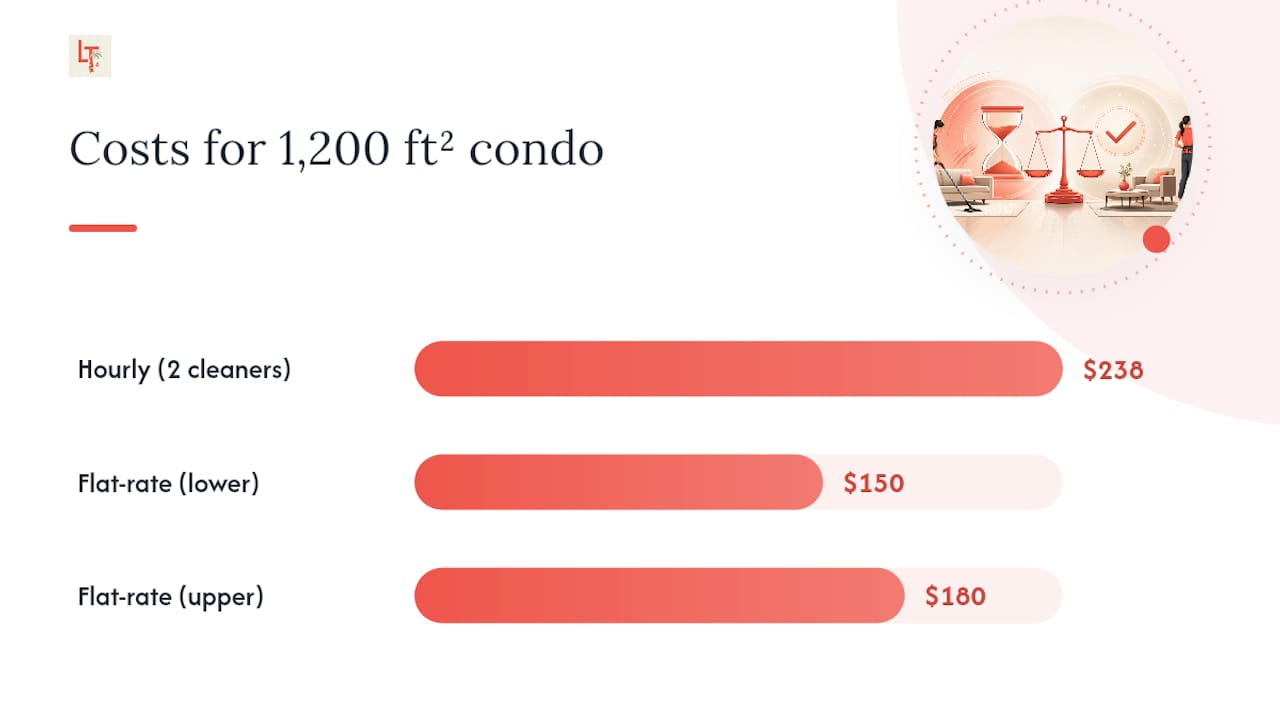
Here’s how the same 1,200-square-foot condo might price out two ways. Billed hourly at two cleaners for two and a half hours at a moderate hourly rate each, you’re looking at a certain total cost. Billed flat-rate for a standard recurring clean of that size, a quote might land closer to $150 to $180, since the company already knows the layout and isn’t padding for uncertainty. That gap is exactly why recurring plans tend to run 10% to 15% cheaper per visit than one-off bookings.
Which Pricing Model Fits Your Situation?
Match your scenario to the model that actually protects your wallet:
- First-ever deep clean: Choose hourly. Nobody can accurately price a home they haven’t seen yet.
- Recurring weekly or biweekly maintenance: Choose flat-rate. The company already knows your space, so efficiency gets rewarded instead of penalized.
- Move-out cleaning: Choose hourly, or a flat-rate quote based on an in-person walkthrough, not a phone estimate. Move-outs often hide damage and buildup landlords will flag later.
- Small apartment, light upkeep: Flat-rate almost always wins here, since the scope is easy to predict.
- Very cluttered or rarely-cleaned home: Start hourly for the first visit, then convert to flat-rate once the baseline is known, exactly the hybrid model most established cleaning businesses already follow.
Watch for these red flags before signing off on any quote, hourly or flat:
- A vague scope with no list of included tasks
- No mention of whether supplies are provided
- No clear number of cleaners or expected visit length
- A price that seems too good for the square footage you gave them
Pro Tip: If a company won’t commit to a hybrid path (hourly first visit, flat-rate after), ask why. A confident answer usually means they’ve done this enough times to trust their own numbers.
Practical Ways to Lower Your Cleaning Bill
A little prep work changes your bill more than most homeowners realize. Before your cleaner arrives, clear countertops, corral toys and loose items, and flag one or two priority rooms if time is tight. Care.com’s guidance on this is blunt: tidy-up work you do yourself directly reduces the time, and cost, a cleaner needs to spend.
Scheduling matters too. Here’s what actually moves the needle:
- Book recurring service. Weekly or biweekly plans typically run cheaper per visit than one-off bookings, since the home stays closer to baseline.
- Ask about off-peak slots. Some companies offer better availability, and occasionally better pricing, for midweek appointments.
- Ask direct questions on the quote call. What’s included, are supplies covered, how many cleaners, is there a travel fee, what’s the cancellation policy?
- Group tasks if you’re on hourly billing. Clear counters and floors in one pass rather than spreading tidying across the visit, since that’s dead time you’re paying for.
Small habits compound. A simple pre-visit checklist followed before every appointment can shave real minutes off an hourly bill or keep a flat-rate visit comfortably inside its scope.
How Limpiezatropical Handles Both Pricing Models
Limpiezatropical builds its pricing around exactly the hybrid path most experienced cleaning businesses recommend. The instant estimate tool gives you a flat-rate number in about 60 seconds, no waiting on a callback to find out what your home will cost.
Here’s what that looks like in practice:
- A first-time or unpredictable job starts as a deep clean, where the team can properly assess a home’s real condition.
- Once your home’s baseline is known, you move to a standard recurring plan at a flat rate, with discounts for weekly, biweekly, or monthly cadence.
- Move-in, move-out, and Airbnb turnover jobs each get their own scope, so you’re never guessing what’s covered.
- Every visit includes complimentary fridge cleaning, and the same local team returns each time, so nobody’s re-learning your home from scratch.
That path, hourly first, flat-rate after, mirrors exactly what the pricing data in this guide supports.
What Homeowners Get Wrong About Cleaning Pricing
Most advice on this topic treats hourly and flat-rate as competing philosophies, as if picking one means rejecting the other forever. That framing doesn’t hold up against how the pricing data actually behaves. The hybrid model isn’t a compromise, it’s the more accurate approach, because it treats pricing as a two-stage problem: first, figure out what a home actually needs, then price the maintenance of that known quantity.
Where conventional advice falls short is in treating flat-rate as automatically “better” for the homeowner. It’s better once your home’s baseline is established. Applied to a first-time deep clean, a flat-rate quote is either padded to cover the unknown, which means you’re overpaying, or too tight, which means the company loses money and eventually cuts corners or raises prices. Hourly billing, for that first visit, isn’t a lesser option. It’s the more honest one.
If there’s one thing to prioritize, it’s asking every cleaning company the same question before booking: “How do you handle pricing for a first visit versus ongoing service?” The answer tells you more about their reliability than any quoted number ever will.
Get a Flat-Rate Quote in 60 Seconds
Limpiezatropical solves the exact problem this guide walks through: not knowing whether hourly or flat-rate makes sense until you’ve seen a real number. Its instant estimate tool skips the back-and-forth phone calls and callback waits that slow down most quote requests, giving you a flat-rate figure for your home in about a minute.
If your home hasn’t had a professional deep clean recently, start there and let the team establish your baseline the same way the hybrid model recommends. From that point, you can move into a recurring standard cleaning plan with discounted flat-rate pricing for weekly, biweekly, or monthly visits, plus complimentary fridge cleaning on every appointment. Homeowners in Miami, Coral Gables, and Doral can check availability and get an instant estimate today.