
How Long Does House Cleaning Take? A Room-by-Room Guide
A standard recurring clean typically takes about one and a half hours on the clock. A deep clean, first-time visit, or move-out job runs closer to around three hours. Those numbers assume a two-person team, since crew size is the single biggest variable in how “house cleaning time” translates from a quote into an actual appointment window.
Here’s the math that matters: cleaning companies often price jobs in labor-hours, not clock-hours. If a job needs 4 labor-hours total, one cleaner working alone takes about 4 hours. Send two cleaners, and the same job typically wraps in around 2 hours. A clocked dataset of cleaning appointments puts the standard-clean median at 1 hour 31 minutes on site, with deep cleans and move-outs clustering closer to 3 hours.
Quick reference for planning your calendar:
- Studio or 1-bedroom: 45 minutes to 1.5 hours standard; 2 to 2.5 hours deep
- 2 to 3-bedroom home: 1.5 to 2.5 hours standard; 3 to 4 hours deep
- 4+ bedroom home: 2.5 to 3.5 hours standard; 4 to 5.5 hours deep
Quick fact: A two-cleaner team roughly halves clock time compared to one person working solo, without changing the total labor-hours billed.
TL;DR:
- A standard cleaning typically takes 60 to 120 minutes with two cleaners, depending on home size, scope, and recent cleaning frequency.
- Deep cleaning or move-out jobs generally require 2.5 to 4 hours with a two-person team, especially if the home has been uncleaned for months.
- Homes with multiple bathrooms, pets, or clutter can extend cleaning times by 20% to 30%, affecting both appointment length and cost.
- Overdue homes and added tasks like inside ovens or fridges can increase cleaning time by up to 50%, making scheduling more unpredictable.
- Using an instant online estimator can generate accurate time and cost estimates in about 60 seconds based on your home’s details and cleaning needs.
Table of Contents
- How Long Does House Cleaning Time Vary by Home Size and Scope?
- What Factors Make a Cleaning Job Take Longer?
- How Do You Estimate Time Room by Room?
- How Do Labor-Hours Turn Into an Actual Appointment Window?
- How Should You Schedule Cleaning Sessions?
- What Actually Saves Time When You Clean?
- What’s the Smartest Way to Get an Accurate Time Estimate?
- Why Most Cleaning-Time Estimates Undersell the Real Variable
- Get Your Time Estimate in 60 Seconds
- Key Takeaways
- Sources
How Long Does House Cleaning Time Vary by Home Size and Scope?
The gap between a standard clean and a deep clean isn’t just a longer to-do list. It’s a different job entirely. Standard cleaning maintains a home that’s already in reasonable shape: wiping surfaces, vacuuming, mopping, bathrooms, and kitchen counters. Deep cleaning tackles buildup that’s been ignored for months: baseboards, grout, inside appliances, window tracks, and corners a weekly clean never reaches.
Here’s how clock time typically breaks down by home size, scope, and crew size:
| Home Size | Standard (Solo) | Standard (2-Person) | Deep (Solo) | Deep (2-Person) |
|---|---|---|---|---|
| Studio / 1BR | 1.5–2 hrs | 45–75 min | 4–5 hrs | 2–2.5 hrs |
| 2BR / 2BA | 2.5–3 hrs | 1.5 hrs | 5.5 hrs | 3 hrs |
| 3BR / 2BA | 3–4 hrs | 1.5–2 hrs | 7 to 8 hrs | 3.5 to 4 hrs |
| 4+ BR / 3BA | 4–5.5 hrs | 2 to 2.5 hrs | 8 to 10 hrs | 4–5.5 hrs |
These ranges assume a home that’s been cleaned somewhat recently. A widely used industry rule estimates about 1 labor-hour per 1,000 square feet for a maintenance clean, and roughly 1.5 labor-hours per 1,000 square feet for a deep clean. A 2,000-square-foot home, in other words, needs about 2 labor-hours standard or 3 labor-hours deep, before you divide by crew size.
A few things change those numbers fast:
- Add-ons stack on top of the base time. Inside-oven cleaning adds roughly 30 to 45 minutes; inside-fridge cleaning adds 20 to 30 minutes; interior windows add 10 to 30 minutes depending on count.
- Overdue homes take longer. A home that hasn’t been professionally cleaned in months can run 30% to 50% longer than the ranges above, since grease, soap scum, and dust get harder to lift the longer they sit.
- Deep-clean frequency matters for planning. Most guidance recommends scheduling a true deep clean every 3 to 6 months, even if you keep up with weekly maintenance in between.
If your home falls into the “it’s been a while” category, plan on the high end of whichever range matches your square footage, and read up on the actual difference between standard and deep cleaning before you book.
What Factors Make a Cleaning Job Take Longer?
Two identical-sized homes can take wildly different amounts of time to clean, and the reason almost always comes down to a handful of predictable variables.
- Bathroom count. Each additional full bathroom adds roughly 30 to 45 minutes depending on how much grime has built up on grout, tile, and fixtures.
- Pets. Homes with multiple pets often run 20% to 30% longer because of fur removal, litter box areas, and paw prints on floors and glass.
- Clutter and surface coverage. A cleaner has to move items before wiping a counter. Every extra minute spent relocating mail, dishes, or toys is a minute not spent actually cleaning.
- Flooring type. Hardwood and tile mop faster than deep-pile carpet, which needs slower, more thorough vacuum passes to lift embedded dirt.
- Household size. More people living in a space generally means more daily wear: more dishes, more bathroom use, more tracked-in dirt.
- Time since the last professional clean. This is the single biggest swing factor, and it compounds with every other item on this list.
- Requested add-ons. Inside cabinets, laundry folding, and interior windows all extend the appointment beyond the base scope.
Pro Tip: A 10-minute tidy before your cleaner arrives, clearing countertops, picking up floor clutter, and loading loose dishes into the sink, is the single highest-return prep step you can take. It lets the crew spend their time actually cleaning surfaces instead of clearing them first.
How Do You Estimate Time Room by Room?
Building your own estimate is easier than it sounds once you know the baseline minutes for each room type. A widely used cleaning-time estimator model uses these defaults for a single cleaner working at a normal pace:
- Bedroom: about 30 minutes standard, 45 to 60 minutes deep (baseboards, under-bed, closet wipe-down)
- Bathroom: about 45 minutes standard, 60 to 75 minutes deep (grout, tile, fixtures)
- Kitchen: 50 to 90 minutes depending on depth, since kitchens and bathrooms are consistently the most time-intensive rooms per square foot
- Living area: about 40 minutes standard, 55 to 70 minutes deep
- Laundry area: 15 to 25 minutes, more if folding or starting a load is included
That same estimator model applies a dirt multiplier to the totals: 0.75 for a lightly soiled home, 1.0 for normal wear, and 1.5 for a deep or first-time clean. Add-ons layer on top: interior windows run about 30 minutes, inside the fridge adds 20 minutes, and the inside of an oven adds 30 to 45 minutes.
Quick fact: A 3-bedroom, 2-bathroom home getting a deep clean adds up to roughly 5.5 solo labor-hours: 3 bedrooms (150 min) + 2 bathrooms (150 min) + kitchen (75 min) + living area (60 min) + laundry (20 min) = about 455 minutes, or 7.6 hours, before applying the 1.5 dirt multiplier for a truly overdue home. With two cleaners splitting the job, that lands close to 3.75 to 4 clock-hours, matching the ranges in the size table above.
How Do Labor-Hours Turn Into an Actual Appointment Window?
Here’s where a lot of confusion happens. A quote that says “4 hours” doesn’t tell you anything useful unless you know how many people are showing up.
If a job is quoted at 4 labor-hours total, one cleaner takes about 4 clock-hours. Two cleaners split it to roughly 2 clock-hours. Three cleaners bring it down near 1.3 to 1.5 clock-hours, since coordination between more people adds a small amount of overhead that pure division doesn’t capture.
| Labor-Hours Quoted | 1 Cleaner | 2 Cleaners | 3 Cleaners |
|---|---|---|---|
| 4 | 4 hrs | 2 hrs | about 1.5 hrs |
| 6 | 6 hrs | 3 hrs | about 2 hrs |
| 8 to 10 | 8 to 10 hrs | 4 to 5 hrs | about 3 hours |
Presenting labor-hours without explaining crew size is one of the most common sources of scheduling confusion between homeowners and cleaning companies. Before you book anything, ask three questions: How many people are coming? What’s on the scope checklist? Are add-ons like inside the oven or fridge already included, or billed separately?
How Should You Schedule Cleaning Sessions?
Getting your cleaning schedule tips right starts with matching frequency to how your home actually gets used.
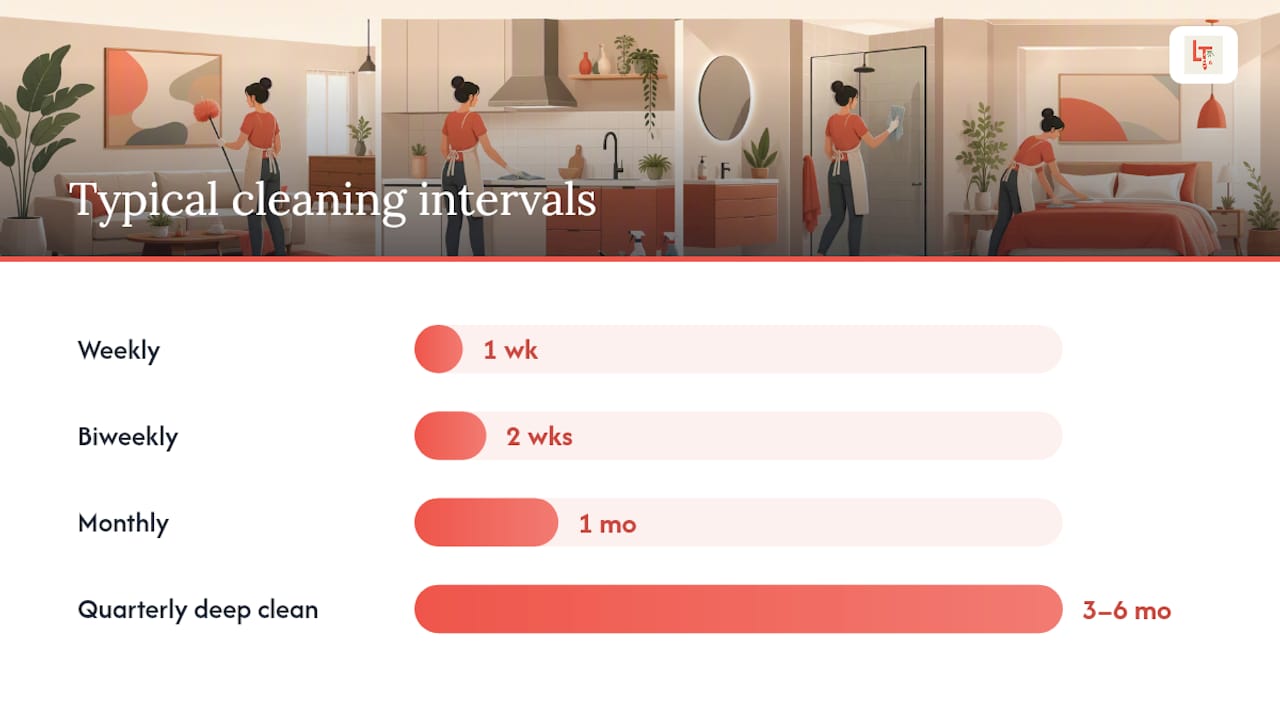
- Weekly: best for busy households, pet owners, or anyone who wants light, fast sessions that never balloon into marathon cleans.
- Biweekly: the most common maintenance cadence, balancing cost against keeping grime from building up.
- Monthly: workable for low-traffic homes, but expect each session to run longer since more time passes between visits.
- Quarterly deep clean: even homes on a tight weekly routine benefit from a seasonal deep reset every 3 to 6 months to catch what regular passes miss.
If a deep clean is going to run past two hours, consider splitting it: tackle bedrooms and living areas one day, kitchen and bathrooms the next, or assign specific zones to different household members.
Pro Tip: Run through a pre-appointment prep checklist the night before a pro arrives. Ten minutes clearing floors and counters routinely shaves real time off the visit, since crews spend it cleaning instead of decluttering.
What Actually Saves Time When You Clean?
Short daily habits beat occasional marathon sessions. Clean Mama’s routine guidance recommends 10 to 15 minute daily maintenance tasks spread across the week, rather than saving everything for one exhausting Saturday.
- Microfiber cloths lift dust and grime faster than paper towels and need fewer passes.
- Multi-surface cleaners cut down on switching products between countertops, glass, and fixtures.
- Robot vacuums handle daily floor maintenance but won’t replace a real vacuum for deep carpet cleaning or edges.
Twenty-minute zone sprints, tackling one room with full focus instead of drifting between several, consistently get more done than an hour of unfocused tidying.
A first-time deep clean, a move-out, or a heavily pet-affected home is usually where hiring a professional deep cleaning service saves more time than any DIY routine could.
What’s the Smartest Way to Get an Accurate Time Estimate?
Every formula in this guide gets you close. None of them account for your specific layout, your grout condition, or how your cats feel about shedding season. That’s the gap Limpiezatropical’s instant estimator is built to close: answer a few questions about your rooms and any add-ons, and it converts that into a real cost and time window in about 60 seconds, no callback required.
The service categories map directly to what’s covered here. Standard cleaning keeps a maintained home on track. Deep cleaning resets a home that’s overdue. Move-in/move-out cleaning handles the intensive push between tenants. Airbnb turnover cleaning covers fast resets between guests. Recurring clients keep the same local team visit after visit, and every appointment includes a complimentary fridge cleaning at no extra charge.
Why Most Cleaning-Time Estimates Undersell the Real Variable
Most cleaning guides treat square footage as the main input and time as the output. That’s backwards. Square footage sets a rough floor, but the actual swing factor, the one that turns a 2-hour job into a 4-hour job, is almost always how long it’s been since the last real clean and how much clutter sits on every surface.
I’d argue the industry undersells this because “it depends on how overdue you are” is a harder sell than a clean per-square-foot number. But the 30% to 50% overdue-home multiplier is bigger than almost any other variable in this guide, bigger than pet ownership, bigger than flooring type, bigger than bathroom count in most cases. If you want a shorter, cheaper appointment, the highest-leverage move isn’t finding a faster cleaner. It’s shrinking the gap between cleanings so no single visit has to fight months of buildup at once.
The other place conventional advice falls short is treating labor-hours and clock-hours as interchangeable. They’re not, and companies that quote one without clarifying the other are setting homeowners up to misjudge their entire day. A 6-labor-hour job sounds like an all-day commitment until you learn two cleaners turn it into a 3-hour window you can plan lunch around.
— Luka
Get Your Time Estimate in 60 Seconds
Limpiezatropical solves the exact planning problem this article walks through: instead of doing labor-hour math yourself, you get a real number in under a minute. The instant estimator turns your home’s size, room count, and any add-ons (inside oven, inside fridge, interior windows) into a calendar-ready time and cost estimate, no waiting on a callback, no guessing which multiplier applies to your situation.

Whether you need a standard recurring visit, a first-time deep clean, or a fast turnover between Airbnb guests, the same local team handles your space every time, and every appointment includes a complimentary fridge cleaning built in. Recurring plans exist specifically for homeowners who’d rather not re-estimate their cleaning time every few weeks. If your home falls into that “it’s been a while” category this guide flagged earlier, get your instant quote for cleaning services today and put a real number on your calendar instead of a guess.
Key Takeaways
Standard house cleaning time runs 60 to 120 minutes with a two-person team, while deep cleans typically require 2.5 to 4 hours, and both depend heavily on crew size and how overdue the home is.
| Point | Details |
|---|---|
| Standard vs. deep clean time | Standard cleans run 60–120 minutes on the clock; deep or move-out cleans run 2.5–4 hours with a two-person team. |
| Team size cuts clock time | A two-cleaner team roughly halves the clock time compared to one cleaner doing the same labor-hours alone. |
| Overdue homes take longer | Homes that skip regular cleanings can run 30% to 50% longer than the standard time ranges. |
| Prep shrinks the visit | A 10-minute tidy clearing counters and floors before a cleaner arrives lets the crew spend more time actually cleaning. |
| Get a real number fast | Limpiezatropical’s instant estimator converts your home size and add-ons into a calendar-ready time and cost estimate in about 60 seconds. |
Sources
- How Long Does House Cleaning Take? (2026 Data)
- How Long Does a House Cleaning Take? (Honest Time Estimates by Home Size) | Queen of Maids
- House Cleaning Time Estimator | Calculate Home Cleaning Hours