
A Medical Office Cleaning Checklist for Miami Clinics
For non-clinical areas of a medical office, require daily high-touch disinfection, restroom sanitation, trash removal, and a signed checklist, then schedule deeper tasks weekly or monthly. This covers your waiting room, reception, restrooms, and administrative spaces. Not exam rooms, not sharps, not clinical decontamination.
Your daily minimum, at a glance:
- Disinfect high-touch surfaces: chairs, counters, door handles, light switches
- Sanitize every restroom, including fixtures and dispensers
- Empty trash and replace liners in every zone
- Sweep and mop or vacuum all flooring
- Wipe down and organize reception surfaces
- Restock soap, paper towels, and hand sanitizer
Put this in writing. Require a signed daily checklist from whoever cleans your office, and if you’re vetting a provider in Miami-Dade, get an instant estimate before your first walkthrough.
Key Takeaways
A medical office cleaning checklist works only when daily high-touch disinfection is paired with EPA-registered products, documented sign-offs, and a written boundary between clinical and non-clinical responsibilities.
| Point | Details |
|---|---|
| Daily high-touch focus | Disinfect chairs, counters, and door handles in the waiting room and reception every day, not just when visibly dirty. |
| Respect dwell time | EPA-registered disinfectants only work if you let them sit on the surface for the label’s full contact time. |
| Draw the clinical line | Sharps, biohazard spills, and exam-room decontamination stay outside a non-clinical cleaning contract, in writing. |
| Documentation drives accountability | Require signed daily checklists, SDS files on-site, and monthly supervisor walkthroughs kept for at least 12 months. |
| Limpiezatropical as the local option | Offers same-crew office cleaning, after-hours scheduling, deep cleaning add-ons, and a 60-second instant estimate for Miami practices. |
Table of Contents
- What Should Be On Your Daily Medical Office Cleaning Checklist?
- How Often Should Deeper Cleaning Tasks Happen?
- What Supplies and Protocols Should You Require?
- What Questions Should You Ask Before Hiring a Cleaner?
- How Do You Choose a Cleaning Schedule and Compare Quotes Fairly?
- How Should You Document and Verify Cleaning Quality?
- How Should Biohazardous Waste Be Handled During Cleaning?
- How Should Medical Equipment and Devices Be Cleaned?
- What Infection Control Standards Apply to Non-Clinical Cleaning?
- Why a Written Checklist Beats Verbal Instructions Every Time
- Get Your Miami Medical Office Cleaned on a Schedule You Control
- Sources
What Should Be On Your Daily Medical Office Cleaning Checklist?
A daily medical office cleaning checklist works zone by zone, not room by room. Skipping around means someone forgets the door handle in reception or the faucet in restroom two. Structure beats memory every time.
Waiting room. Wipe down every chair arm and seat back, not just the ones that look used. Clean tabletops, remove outdated magazines (they’re a touchpoint nobody thinks about), and disinfect door handles and push plates. Patients form an impression of a facility within seconds of walking in, so this zone carries more weight than its square footage suggests.
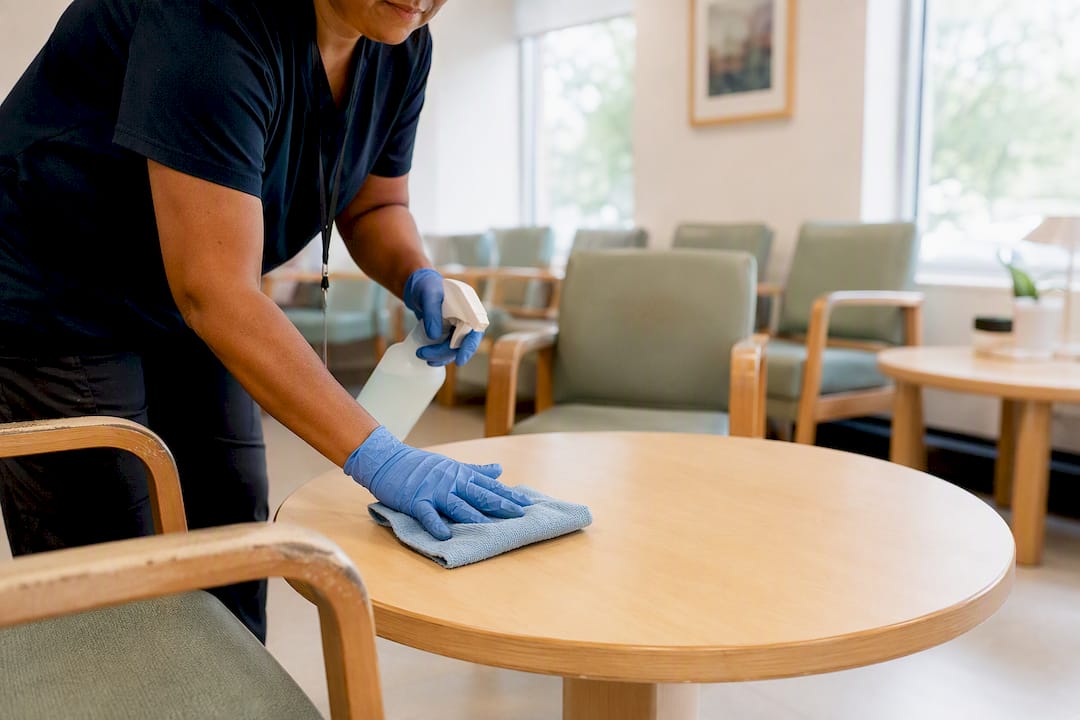
Reception. The front desk collects more bacteria than almost any other surface because of shared pens, clipboards, and payment terminals. Wipe the counter, keyboards, phones, and card reader with disposable wipes rated for electronics, then disinfect the counter surface itself.
Restrooms. Clean and disinfect toilets, sinks, faucet handles, and dispenser buttons. Mop floors with a fresh solution, not the mop that just came out of the break room.
Offices and admin spaces. Wipe desks, shared phones, and light switches. Empty trash daily even if it looks half full.
Break room. Disinfect the refrigerator door handle, microwave buttons, and sink faucet. Appliance exteriors matter more here than most offices realize, since staff touch them with bare hands between patients.
- Remove visible soil and clutter first
- Clean surfaces with an appropriate solution
- Disinfect high-touch points last, and let the product sit for its labeled dwell time before wiping
That third step gets skipped constantly. Spraying and immediately wiping dry defeats the purpose of the disinfectant. If the label says 4 minutes, it needs 4 minutes.
Staff cleaning these areas should wear gloves at minimum, and eye protection when handling concentrated products before dilution. Anyone using disinfectant chemicals should be trained to read and follow the product label, not go by habit.
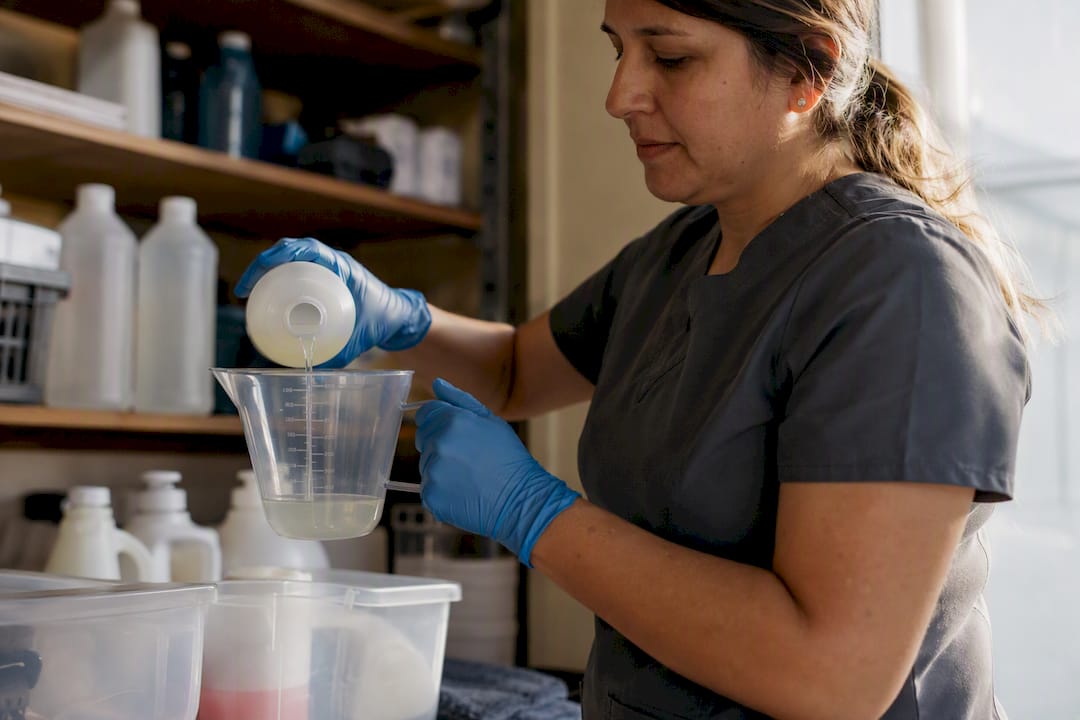
Pro Tip: Post the dwell time for your primary disinfectant on the supply cart itself. Cleaning crews rotate, and a visible reminder beats relying on someone remembering a number from training three months ago.
How Often Should Deeper Cleaning Tasks Happen?
Daily tasks keep a medical office presentable. Weekly and periodic tasks keep it actually clean, and this is where most offices fall short because these jobs are easy to postpone indefinitely.
Weekly:
- Vacuum upholstered chairs and detail-dust surfaces, daily wiping skips (baseboards, blinds, vents)
- Mop hard floors with a full-strength cleaning solution, not just a quick pass
- Clean water fountains and, if present, the office refrigerator interior
Monthly or quarterly:
- Extract carpets rather than just vacuuming them
- Clean interior windows and glass partitions
- Dust HVAC vents and return grilles
- Strip and wax hard flooring where the surface calls for it
Certain events should trigger an unscheduled deep clean regardless of your calendar: a documented illness outbreak among staff or patients, the peak of flu season, a change in tenants or office layout, or visible soil buildup that daily service isn’t touching. Waiting for the next scheduled deep clean when one of these hits is how offices end up with a bigger problem later.
What Supplies and Protocols Should You Require?
Cleaning, sanitizing, and disinfecting are not interchangeable, and knowing the difference helps you evaluate a vendor’s actual protocol instead of their marketing language. Cleaning removes visible dirt. Sanitizing reduces germs to a safer level. Disinfecting kills a higher percentage of pathogens on a surface, and it’s the standard you want for high-touch points like door handles, counters, and restroom fixtures.
For non-clinical areas, require vendors to use EPA-registered disinfectants and to actually follow the label’s contact time. Providers who ground their programs in CDC cleaning and disinfection guidance tend to treat dwell time as non-negotiable rather than a suggestion.
Beyond the product itself, ask about:
- Color-coded microfiber systems, so a cloth used in a restroom never touches a reception counter
- Fresh mop heads per zone, not one mop dragged through the entire office
- Disposable single-use wipes for phones, keyboards, and payment terminals
- Locked, labeled chemical storage with Safety Data Sheets on-site and accessible
One boundary matters more than any supply list: exam-room decontamination, sharps handling, and regulated medical waste are clinical responsibilities, not part of a non-clinical cleaning contract. That line needs to be drawn explicitly during the walkthrough, in writing, so nobody assumes it’s covered.
What Questions Should You Ask Before Hiring a Cleaner?
Vetting a cleaning provider for a medical office takes more scrutiny than hiring one for a retail space, because the standard for documentation and training runs higher. Commercial cleaning providers serving healthcare-adjacent clients typically distinguish themselves on training and paperwork, not just price.
Ask these questions directly:
- Does your staff have OSHA Bloodborne Pathogens awareness training, even for non-clinical zones?
- What EPA-registered disinfectants do you use, and can you show contact-time compliance?
- Do you run background checks on cleaning staff who’ll have unsupervised access after hours?
- Will the same crew be assigned to our office each visit, or does staffing rotate?
- Can you provide references from other medical or professional offices in the area?
Then request documentation before signing anything: sample cleaning logs or checklists, SDS files for every chemical used on-site, proof of insurance and bonding, staff training records, and a written protocol for handling a spill or incident.
Your contract should spell out after-hours scheduling, a line-item scope broken down by zone, visit frequency, and how pricing was determined. Pricing that isn’t based on an actual walkthrough of your space is a guess, not a quote.
Pro Tip: Ask a prospective vendor to email you a blank sample checklist before you sign anything. If they can’t produce one on request, they probably aren’t using one in the field either.
How Do You Choose a Cleaning Schedule and Compare Quotes Fairly?
The right cleaning cadence depends on how much foot traffic and touchpoint activity your office actually generates, not on what a neighboring practice does.
- Low-volume administrative office (billing, records, minimal patient visits): light service 3 to 5 times a week covers it
- Moderate medical practice (steady daily patient flow): daily high-touch disinfection plus nightly trash and restroom service
- Busy clinic (high patient volume, multiple providers): multiple touchpoint checks throughout the day, plus a nightly deep clean
Quotes vary for real reasons: visit frequency, square footage, restroom count, and any periodic tasks like carpet extraction or window cleaning factored into the contract. After-hours service and documentation requirements add cost too. Outsourced medical-adjacent cleaning commonly runs a 25 to 50 percent premium over general office cleaning, largely because of the protocols and training involved.
Insist on a walkthrough before accepting a quote. It’s the only way to compare providers on equal terms, and it exposes the hidden cost of having front-desk or clinical staff doing custodial work between patients instead of their actual jobs.
How Should You Document and Verify Cleaning Quality?
Documentation is what turns “we think it’s clean” into proof. Keep these records on hand:
- Daily checklists signed by the technician who completed the work
- Weekly supervisor spot-checks, separate from the technician’s own sign-off
- SDS and chemical-handling files accessible on-site, not buried in an email somewhere
- An incident log for spills, complaints, or missed tasks
- Photo evidence for recurring problem areas
The practical workflow: require digital checklists or photographed sign-offs per visit, run a supervisor walkthrough monthly, and retain records for at least 12 months. Audit-ready documentation with timestamps resolves disputes before they escalate.
There’s a budget argument here too. Outsourced, well-documented cleaning programs are linked to lower staff absenteeism and stronger patient impressions, which is the case to make when a practice owner questions the line item.
How Should Biohazardous Waste Be Handled During Cleaning?
Biohazardous waste, anything contaminated with blood, bodily fluids, or sharps, falls outside the scope of a standard non-clinical cleaning contract, and that boundary needs to be explicit before your provider starts work.
Your cleaning vendor’s job in non-clinical areas is limited to general trash: paper towels, food waste, packaging. If a biohazard bag or sharps container appears in a waiting room, reception, or break room (a used bandage, a dropped test strip), it should never go into a standard trash liner. Regulated medical waste requires its own labeled containers, a licensed medical waste disposal service, and chain-of-custody documentation, none of which a general cleaning crew is equipped or authorized to manage.
This is why the walkthrough matters so much. Define, in writing, who is responsible if biohazard material turns up in a non-clinical zone. In most small practices, that’s still clinical staff, not the cleaning crew, because handling it requires specific PPE and disposal training your cleaning vendor likely doesn’t carry.
What your cleaning contract should specify is a clear escalation step: if the crew finds anything they suspect is biohazardous, they stop, don’t touch it, and notify office management immediately. That single instruction, written into the service agreement, closes a gap that a lot of practices never think to address until something goes wrong.
How Should Medical Equipment and Devices Be Cleaned?
Shared equipment in non-clinical areas, a blood pressure cuff in the waiting room, a check-in kiosk, a payment terminal, needs a cleaning approach that’s different from wiping a counter, even though none of it is clinical equipment in the strict sense.
Electronic devices (kiosks, tablets, card readers, keyboards, phones) should be cleaned with disposable wipes specifically labeled safe for electronics. Standard disinfectant sprays can damage screens and seep into ports, so this isn’t just a cleanliness question, it’s a maintenance one. Wipe, don’t spray directly.
Any equipment with a manufacturer cleaning guide (self-check-in kiosks are the common example in a waiting room) should be cleaned according to that manufacturer’s instructions first. A general-purpose disinfectant that isn’t compatible with a touchscreen coating can cloud or degrade it over time.
Clinical equipment, exam tables, diagnostic tools, anything used directly on a patient, sits entirely outside a non-clinical cleaning contract. That distinction should be stated plainly in your service agreement so there’s no ambiguity about who handles what. A cleaning crew wiping down a check-in kiosk is appropriate. A cleaning crew touching anything in an exam room is a liability nobody wants to discover after the fact.
What Infection Control Standards Apply to Non-Clinical Cleaning?
Two federal frameworks shape how a medical office should approach cleaning, even in areas that never see clinical procedures.
OSHA’s Bloodborne Pathogens Standard requires training for anyone who could reasonably encounter blood or bodily fluids on the job, and this extends to cleaning staff in a medical office, even in waiting rooms and restrooms, because incidental exposure is possible. This is why “OSHA Bloodborne Pathogens awareness training” belongs on your vendor-vetting checklist, not just for exam-room staff.
CDC guidance on cleaning and disinfection in healthcare settings emphasizes defining clinical versus non-clinical responsibilities clearly, and following product label directions for contact time rather than treating disinfectant use as a rinse-and-wipe step. Most facility managers don’t realize how much cross-contamination risk comes from skipping that boundary conversation entirely.
Neither standard requires your reception area to meet exam-room disinfection protocols. What they do require is a documented, deliberate approach: trained staff, EPA-registered products used correctly, and a clear line between what your cleaning vendor handles and what stays with clinical personnel. That’s the whole point of putting a checklist and a contract in writing instead of assuming everyone understands the boundaries the same way.
Why a Written Checklist Beats Verbal Instructions Every Time
The conventional advice on medical office cleaning treats it as a commodity decision: get three quotes, pick the cheapest, move on. That’s backwards for a healthcare-adjacent space, and it’s the single biggest mistake I see practices make.
What actually matters is documentation, not price. A vendor who hands you a signed daily checklist, shows you their SDS files unprompted, and assigns the same crew every visit is solving a problem most practices don’t know they have: liability exposure from undocumented, inconsistent cleaning. A cheaper vendor who can’t produce those records isn’t actually cheaper once you factor in staff time spent double-checking their work or the risk of an inspection catching a gap.
The other overlooked piece is boundary-setting. Practices assume a general cleaning crew understands where non-clinical cleaning ends and clinical responsibility begins. Assumption is not a policy. Put it in writing at the walkthrough, before the first invoice.
Start with the checklist, not the price sheet. Everything else, scheduling, cost, credentials, gets easier to evaluate once you know exactly what you’re asking a vendor to be accountable for.
— Luka
Get Your Miami Medical Office Cleaned on a Schedule You Control
Limpiezatropical gives Miami-area medical offices what a checklist alone can’t: a local crew that shows up, follows the documented protocol, and gets billed with pricing you already know before the visit starts, thanks to an instant estimate built to take about 60 seconds instead of waiting on a callback.
For non-clinical zones, waiting room, reception, restrooms, and admin space, Limpiezatropical’s office and commercial cleaning service covers the daily high-touch disinfection this checklist calls for, with the same assigned team on every visit so nothing gets lost in translation between crews. Practices that want periodic upgrades, carpet extraction, internal windows, a full reset between tenants, can add deep cleaning on top of a standard schedule. After-hours scheduling is available for offices that don’t want a cleaning crew working around patient flow during the day.
Recurring clients on a cleaning plan get member pricing and, as a standing perk on every visit, complimentary fridge cleaning for the break room. If your practice is ready to see real numbers instead of a ballpark, get your instant estimate or request a walkthrough today.
Sources
These sources shaped the standards behind this checklist:
- Cleaning and Disinfection for Healthcare Settings | CDC
- ES and the patient-centered promise | Healthcare Facilities Management Magazine
- Commercial cleaning for healthcare facilities: How to choose a provider (2026 Guide) | Valentin Services Group