
Office Cleaning Checklist for Managers (With Time & Cost Tips)
A working office cleaning checklist runs on three frequency tiers: daily tasks that protect hygiene, weekly tasks that stop buildup before it becomes visible, and monthly or quarterly tasks that protect your carpets, furniture, and HVAC investment. Each tier covers specific zones, reception, workstations, conference rooms, the break room, restrooms, and common areas, with clear ownership so nothing falls through the cracks.
The split matters because appearance and hygiene aren’t the same job. A desk can look spotless and still carry bacteria on the phone receiver or the shared keyboard. Facility teams that separate these two categories avoid what commercial cleaning experts call cleaning theater, where a space looks tidy but hasn’t actually been disinfected where it counts.
Here’s the split in three lines:
- Daily: Trash, high-touch disinfection, restrooms, restocking, and a quick surface wipe across every zone.
- Weekly: Deep dusting, interior glass, full floor mopping, appliance exteriors, and a fridge clean-out.
- Monthly/quarterly: Carpet extraction, upholstery shampoo, HVAC vents, interior windows, and floor refinishing.
Table of Contents
- Daily Office Cleaning Checklist by Area
- Weekly Office Cleaning Tasks That Prevent Buildup
- Monthly and Quarterly Deep-Clean Tasks
- How to Assign Tasks and Estimate Cleaning Time and Cost
- Supplies, Equipment, and Safety Practices for Office Cleaning
- A Printable Office Cleaning Checklist Template
- Hiring a Professional Team When the Checklist Isn’t Enough
- Sources
Daily Office Cleaning Checklist by Area
Daily tasks are the ones you can’t skip without consequences showing up within 24 to 48 hours. Skip a Monday vacuum and nobody notices. Skip restroom disinfection or trash removal and you’ll hear about it by lunch.
Build the daily route around zones, not a single master list, so whoever runs the shift can move logically from front door to back office.
- Reception and entryway (8 to 10 minutes). Wipe the front desk, sanitize the entry door handles, spot-clean glass doors, and empty visible trash. Reception sets the first impression, so it gets a full pass every single day.
- **Open workstations and cubicles (12 to 15 minutes). Disinfect shared touchpoints, desk phones, keyboards left out overnight, and light switches. Empty individual trash bins and reset chairs.
- Private offices (5 to 8 minutes). Empty trash, wipe down desk surfaces if accessible, and spot-clean any visible marks on doors or walls.
- Conference rooms (6 to 10 minutes per room). Wipe the table, sanitize chair arms, clean the whiteboard, and check that the room is reset for the next meeting.
- Break room and kitchen (10 to 15 minutes). Wipe counters, sanitize the microwave door and handle, clean the sink, empty trash and recycling, and restock napkins.
- Restrooms (15 to 20 minutes per restroom). Disinfect toilets, sinks, and door handles, restock paper towels, toilet paper, and soap, and empty trash. This is the single highest-priority daily zone.
- Hallways and common areas (8 to 10 minutes). Spot-vacuum or dust-mop high-traffic paths, empty communal trash, and wipe down elevator buttons or shared equipment.
- Shared equipment (5 minutes). Disinfect printer buttons, phone handsets in shared spaces, and any touchscreen or badge reader near entrances.
Every task should end with a completion field. A simple line for initials or a time stamp, whether on paper or in a mobile app, turns a checklist into an audit trail. SafetyCulture’s checklist templates build signature fields directly into daily and weekly formats for exactly this reason: without a record, nobody can prove the restroom was actually serviced at 9 a.m. versus just marked as done.
Pro Tip: Work high-touch surfaces first, before dust settles from vacuuming or wiping desks. Spray your EPA-registered disinfectant, then move to the next surface while it sits for its full dwell time (often one to ten minutes depending on the product) rather than wiping it off immediately. Skipping dwell time is the most common reason “disinfected” surfaces stay contaminated.
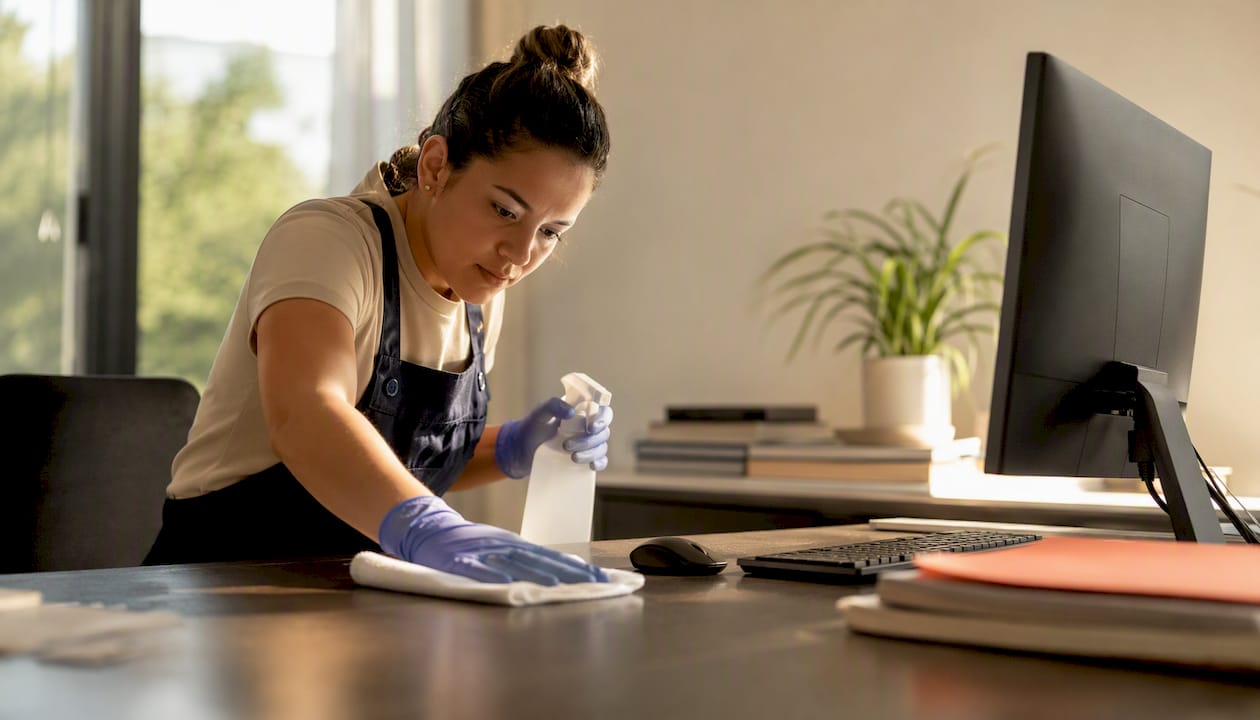
The World Health Organization draws a hard line between cleaning, which removes visible dirt, and disinfecting, which reduces pathogen load. Both matter, but only one kills germs, and it only works if the surface stays wet for the time the label specifies.
Weekly Office Cleaning Tasks That Prevent Buildup
Weekly tasks catch what daily wiping misses. Dust doesn’t accumulate in a day, but give it seven, and it’s visible on monitor tops, vent covers, and blinds. The weekly route exists to reset the whole space before grime becomes a maintenance problem.
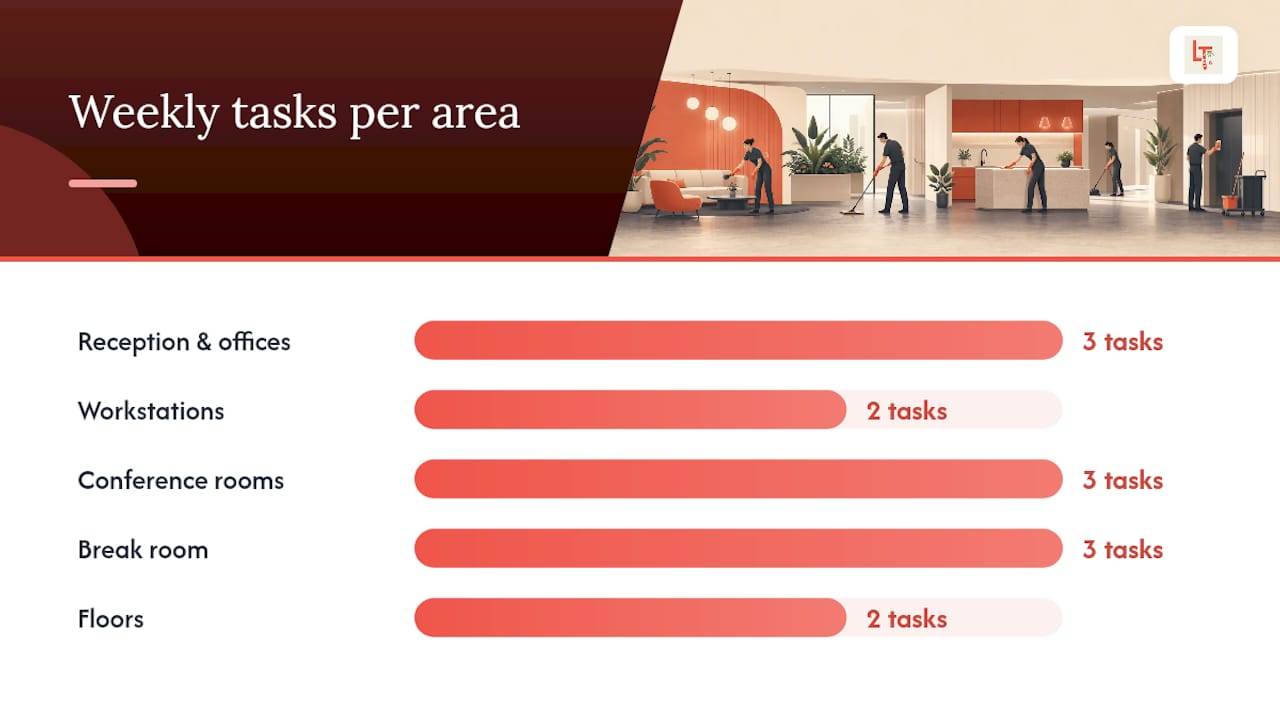
Run these by area:
- Reception and offices: Dust all horizontal surfaces including shelves and picture frames, clean interior glass and mirrors, and wipe baseboards along main walkways.
- Workstations: Vacuum under desks and along carpet edges where daily vacuuming often gets skipped, and wipe down monitor stands and cable organizers.
- Conference rooms: Do a full wipe-down of chairs, credenzas, and any AV equipment housing, not just the table surface.
- Break room: Clean appliance exteriors, including the microwave interior and coffee maker housing, wipe down the fridge exterior, and do a quick interior fridge check for expired items.
- Floors: Mop all hard-surface floors fully, rather than the daily spot-mop, and run a full vacuum pass across all carpeted areas.
Supervisors should spot-check at least three completed weekly items per visit and log the result on the same sheet the crew uses. That could mean confirming the fridge was actually cleaned out, not just wiped on the outside, or checking that baseboards show no dust when you run a finger along them. Facility Management Insights recommends building this kind of audit around consequence: ask what happens if a weekly task is skipped for a month, and that answer tells you how tightly to supervise it.
Track consumables used during the weekly route on the same log, paper towels, glass cleaner, mop solution, so restocking orders match actual usage instead of guesswork.
Pro Tip: Assign one person to “own” the fridge and appliance interiors every week. Shared ownership of unpleasant tasks means nobody actually does them consistently; a named owner means it happens on schedule.
Monthly and Quarterly Deep-Clean Tasks
Monthly and quarterly work protects the assets that cost real money to replace: carpet, upholstery, HVAC systems, and floor finishes. These tasks don’t affect day-to-day hygiene as directly, but skip them long enough and you’re looking at replacement costs instead of maintenance costs.
| Task | Suggested frequency | Recommended performer |
|---|---|---|
| Carpet extraction | Quarterly | Specialist vendor |
| Upholstery shampoo | Quarterly | Specialist vendor or day porter with equipment |
| HVAC vent and return-grille cleaning | Quarterly | In-house or building maintenance |
| Interior window cleaning | Monthly | Day porter or in-house team |
| Floor stripping and refinishing (hard floors) | Semiannually to annually | Specialist vendor |
| Floor burnishing (maintenance polish) | Monthly | In-house or day porter |
Coordinate vent cleaning with your building’s broader maintenance calendar. A preventive HVAC maintenance schedule usually already includes filter changes on a similar cadence, so pairing the two visits saves a separate vendor trip.
Most offices don’t need weekly carpet extraction, but three warning signs mean you should move the timeline up regardless of what the calendar says.
Pro Tip: Watch for a persistent musty odor near carpeted areas, visible fiber wear in high-traffic paths, or a stain that reappears after cleaning. Any one of those means the fiber is holding contamination deeper than surface vacuuming reaches, and it’s time to call a specialist before the quarter is up. If your office has never had a proper deep clean versus routine maintenance, it’s worth understanding the difference before you budget for either.
How to Assign Tasks and Estimate Cleaning Time and Cost
A checklist without owners and time budgets is just a wish list. Converting it into a real schedule takes three pieces: who does each task, how long it takes, and what it costs per visit.
- Build a time-budget table. List every task with a minutes estimate and an owner, then sum the minutes by shift. A typical daily route across reception, ten workstations, two conference rooms, a break room, and two restrooms usually runs about one and a half to two hours for one person. Add the weekly tasks on their scheduled day and the route extends by another 45 to 60 minutes.
- Assign owners by task type, not just by shift. A day porter handles daytime restocking and spot response, a night crew handles the bulk of disinfection and floor work, and an external vendor handles quarterly deep cleans. Property managers coordinating multiple vendors on one site often find that assigning clear daily duties prevents the common gap where everyone assumes someone else covered a task.
- Estimate labor cost with a simple formula. Multiply total minutes per visit by your hourly labor rate, divide by 60, then add a supply-cost factor for consumables like liners, paper products, and disinfectant. A 100-minute nightly route at a $20 hourly rate runs roughly $33 in labor, plus $2 to $3 in supplies, before any markup for a contracted vendor.
- Verify with completion fields, not assumptions. Every task on the sheet needs a place for initials, a time stamp, or a photo. Photo verification works especially well for restrooms and break rooms, where “clean” is subjective until someone can see it.
- Run supervisor spot-checks weekly, not monthly. A five-minute walkthrough catching three or four random tasks each week surfaces problems before they compound into a client complaint or an employee health concern.
Facility teams that add zone, frequency, owner, and a completion standard to every line find the schedule translates cleanly into a CMMS or mobile task app later, since the fields are already structured for digital tracking.
Supplies, Equipment, and Safety Practices for Office Cleaning
The right supplies make the difference between a checklist that actually disinfects and one that just moves dirt around. Stock these categories before you finalize the schedule:
- HEPA-filter vacuums for carpeted areas, especially in offices with employees who have allergies or asthma.
- Microfiber cloth systems, color-coded by zone (one color for restrooms, another for kitchen surfaces, another for general dusting) to prevent cross-contamination.
- EPA-registered disinfectants matched to your actual surfaces; not every disinfectant is safe on every material, so check the label before bulk-ordering one product for everything.
- Auto-scrubbers for offices with large hard-floor square footage, since manual mopping struggles to keep pace with heavy foot traffic.
- Restroom restocking supplies: toilet paper, paper towels, and soap, tracked on the same log as your weekly consumables count.
Safety has to move alongside supply stocking, not as an afterthought. OSHA’s workplace safety guidance covers PPE requirements and safe chemical handling for cleaning staff, and every site should keep Safety Data Sheets accessible for each product in use, not filed away in a manager’s office nobody can reach during a shift.
Dilution ratios and dwell times aren’t suggestions. A disinfectant diluted too weak won’t kill what it claims to on the label, and one used at full strength without ventilation can irritate airways in a closed office space. Store chemicals in a ventilated area away from food service supplies, and train new staff on both the dilution chart and the label’s required contact time before their first solo shift.
Pro Tip: Run a monthly supplies audit sheet that tracks what’s on hand versus what got used. If a disinfectant runs out faster than the schedule predicts, staff may be over-diluting to stretch it, which quietly undercuts every disinfection task on your daily checklist.
A Printable Office Cleaning Checklist Template
A checklist only works if it’s physically where the crew needs it, taped inside the supply closet, clipped to a rolling cart, or loaded onto a phone. Structure yours with these columns so it covers every zone without requiring a separate sheet per room.
For a quick-start version, pull your ten to fifteen highest-priority daily items straight from the area breakdown above: reception wipe-down, workstation disinfection, restroom service, break room reset, conference room wipe, trash removal across every zone, and shared equipment sanitizing. Print that shortened list first and expand once the crew has the routine down.
Digitizing it later is straightforward. Add photo-evidence fields so completion means a visible before-and-after, time stamps so supervisors know when each zone was actually serviced, and if your office already uses a maintenance app or CMMS, port the same zone/task/frequency/owner columns directly into it. Nothing about the structure changes, only the medium.
Renters facing an end-of-lease inspection use a similar structure, and Limpieza Tropical’s move-out cleaning checklist shows how the same zone-and-signature format adapts to a one-time deep clean instead of a recurring schedule.
What experienced cleaning teams do differently
The teams that keep an office consistently clean, not just clean on inspection day, share one habit: they assign zone ownership and stick to it. When the same person handles restrooms every single day, they notice the soap dispenser that’s about to run dry before it actually does. Rotate that responsibility daily and everyone assumes someone else caught it.
The single change that improves adherence fastest is pairing new staff with an experienced team member for the first two weeks, rather than handing them a checklist and a supply closet key. Checklists tell you what to do; they don’t teach dwell times, dilution habits, or which conference room always has gum under the table. A short weekly five-minute spot audit, three random tasks checked against the log, catches drift before it becomes a pattern.
Hiring a Professional Team When the Checklist Isn’t Enough
Some jobs on this checklist are worth outsourcing even if your in-house crew handles daily tasks well. Deep carpet stains, upholstery shampooing, large square footage that needs an auto-scrubber, or a recurring schedule you don’t want to manage in-house all point toward professional help rather than another line item on someone’s overloaded task list.
Limpieza Tropical handles office and commercial cleaning across reception, workstations, conference rooms, break rooms, and restrooms, with supplies included on every visit and the same local team returning each time so you’re not re-explaining your space to a new crew. If you’re weighing in-house staffing against a recurring professional visit, getting a real number takes about 60 seconds through the instant estimate tool: have your square footage, restroom count, primary floor types, and desired frequency ready, and the estimate comes back without a callback or a sales call.
Recurring clients also get plan-based discounts and a complimentary fridge cleaning with every visit, a small detail that matters more than it sounds once you’ve tried to get someone in-house to volunteer for that task weekly. Check current plans and services to see whether a recurring visit fits your budget better than adding more hours to a night crew’s route.
Quick recap and next steps
A working office cleaning checklist splits tasks into daily, weekly, and monthly tiers, and the daily tier’s high-touch disinfection matters more for health than anything else on the list.
| Point | Details |
|---|---|
| Separate hygiene from appearance | Disinfect high-touch surfaces daily regardless of how clean a space looks, to avoid cleaning theater. |
| Build in completion fields | Every task needs a signature, time stamp, or photo so supervisors can audit instead of assume. |
| Estimate cost with a simple formula | Multiply minutes per visit by hourly rate, then add 5% to 10% for supply costs. |
| Schedule deep-clean tasks by cadence | Map carpets, upholstery, and HVAC vents to monthly or quarterly frequencies with a named owner. |
| Outsource when scope outgrows staff | Limpieza Tropical offers office cleaning with an instant estimate tool for teams weighing in-house versus professional service. |
Where to go for deeper guidance
- OSHA covers PPE standards and safe chemical handling for cleaning staff.
- WHO’s guidance on cleaning and disinfecting surfaces explains the difference between routine cleaning and disinfection.
- SafetyCulture’s checklist library offers downloadable templates with built-in signature fields.
- Facility Management Insights breaks down how to build a schedule by zone and consequence for larger or multi-tenant facilities.
Sources
- OSHA
- WHO — Cleaning and disinfecting surfaces in non-health-care settings
- Office Cleaning Schedule Checklist: Daily & Weekly | Free Template — SafetyCulture library
- Office Cleaning Schedule Template: A Complete Guide (2026) — Facility Management Insights