
What to Include in an Office Cleaning Scope of Work
An office cleaning scope of work is a single document that names every space, every task, and the frequency and standard by which each task gets measured. That’s it. If your current cleaning contract can’t answer “who cleans what, how often, and how do we know it’s done right,” you don’t have a scope of work. You have a handshake deal wearing a contract’s clothes.
I’ve watched too many facility managers get burned by vague language like “general nightly cleaning” only to find out three months in that “general” meant something completely different to the vendor than it did to them. A real office cleaning scope of work fixes that before it starts. Here’s the six-item checklist every solid SOW needs:
- Areas and square footage — every room, hallway, and shared space, ideally tied to a floor plan
- Task list per area — specific action verbs, not vague category names
- Frequency per task — daily, weekly, monthly, or periodic, spelled out
- Supplies and responsibility — who provides paper products, liners, and equipment
- Quality standards and KPIs — pass/fail criteria and inspection cadence
- Change control and exclusions — what’s not included and how add-ons get priced
Here’s sample clause language you can drop straight into an RFP: “Contractor shall provide nightly cleaning services for the premises described in Exhibit A, including all tasks listed in Exhibit B at the frequencies specified therein. Contractor shall supply all consumable restroom and kitchen products unless otherwise noted. Service quality will be evaluated per the inspection protocol in Exhibit C, with corrective action required within 24 hours of a documented deficiency.”
Pro Tip: Print this checklist and pin it above your desk during vendor walkthroughs. If a bidder can’t answer all six items on the spot, that’s your first red flag.
You’ll find a full downloadable version of this template, plus a one-page daily/weekly/monthly checklist for crews and inspectors, later in this guide.
Key Takeaways
A defensible office cleaning scope of work names every space, every task, its frequency, and the standard by which it gets inspected, with no room left for a vendor’s assumptions to fill the gaps.
| Point | Details |
|---|---|
| Map every space first | List areas by square footage and attach a floor plan before requesting any pricing. |
| Write measurable task language | Use action verbs plus a “done” condition so inspections stay objective, not subjective. |
| Separate hygiene from appearance tasks | Restroom disinfection and high-touch wipe-downs deserve their own inspection line items. |
| Request line-item pricing | Ask every bidder to break out labor, consumables, and periodic charges separately. |
| Limpiezatropical delivers priced proposals fast | An instant estimation tool converts your scope details into a real quote in about 60 seconds. |
Where to find more on office cleaning standards and templates
- ISSA’s education resources cover industry-recognized cleaning methods and frequency benchmarks worth comparing your own SOW against.
- Advanced Building Care’s SOW breakdown outlines the seven core elements a usable office scope needs to include.
- House of Stone Place’s template guide walks through building a full SOW document section by section.
- Allied Facility Care’s frequency checklist breaks daily, weekly, and quarterly tasks down by category.
- Procurement-ready PDF templates and RFP attachments are typically available directly through cleaning industry associations or your own legal or procurement department, formatted to match your organization’s contract standards.
Table of Contents
- What Areas Does an Office Cleaning Scope of Work Cover?
- What Tasks Belong in an Office Cleaning Checklist?
- How Often Should Each Office Cleaning Task Happen?
- How Do You Measure Cleaning Quality and Performance?
- Who Provides Staffing, Equipment, and Supplies?
- How Do You Price an Office Cleaning Contract?
- What Should Be Excluded From an Office Cleaning Scope?
- Can I Use a Sample SOW Template for My Office?
- How Does This Look in a Real Office Cleaning Quote?
- How Limpiezatropical Can Help You Build a Contract-Ready SOW
- Frequently Asked Questions About Office Cleaning Scopes of Work
- Sources
What Areas Does an Office Cleaning Scope of Work Cover?
Before anyone talks tasks or pricing, you need a map. Bidders can’t quote accurately, and you can’t hold anyone accountable, if the physical scope isn’t nailed down on paper.
Start with a room-by-room inventory. A typical office SOW breaks the space into: reception and lobby, private offices, open workstation areas, conference and meeting rooms, restrooms, breakrooms or kitchenettes, corridors and stairwells, storage closets, server or IT rooms, and exterior entryways. Windows reachable from standing height usually fall inside the base scope too, while anything requiring a ladder or lift typically gets priced separately.

Attach an actual floor plan if you have one, even a rough one from your leasing office. Note total square footage by area type, since restroom square footage is priced very differently from open office square footage due to labor intensity. If you’re in a multi-tenant building, mark clearly which spaces are shared common areas managed by the building versus spaces that are your tenant responsibility. This single distinction causes more billing disputes than almost anything else in commercial cleaning.
Responsibility for supplies, access, and waste removal needs to be assigned by area, not left as a blanket statement.
| Area | Typical Responsibility | Notes |
|---|---|---|
| Restrooms | Vendor supplies paper, soap, liners | Client provides storage closet access |
| Breakroom/kitchen | Shared: vendor cleans, client restocks food-adjacent items | Vendor typically excludes inside-fridge cleaning |
| Workstations | Vendor empties trash, dusts, vacuums | Client responsible for personal items and desk clutter |
| Server/IT room | Limited vendor access, dust only | Client controls key/badge access, security clearance |
| Exterior entryway | Vendor sweeps, mats, glass | Building management may own sidewalk/landscaping |
That table alone can settle half the disputes that show up mid-contract.
What Tasks Belong in an Office Cleaning Checklist?
This is the meat of the document, and it’s where most SOWs fall apart from vagueness. A checklist that says “clean restrooms” is worthless. A checklist that says “disinfect toilets and urinal surfaces free of visible soil; restock dispensers to specified par levels” is enforceable.
Separate your tasks into two categories: appearance tasks and hygiene tasks. Appearance tasks (dusting, glass cleaning, emptying trash, vacuuming) are what a visitor notices first. Hygiene tasks (restroom disinfection, high-touch surface wipe-downs) are what actually drives employee complaints when they’re skipped, since people notice a dirty toilet far faster than a dusty shelf.
Daily tasks typically include:
- Empty and reline all trash and recycling receptacles
- Disinfect restroom fixtures, dispensers, and touch points
- Wipe down high-touch surfaces (door handles, light switches, elevator buttons)
- Vacuum high-traffic carpet areas and spot-mop hard floors
- Wipe kitchen and breakroom counters, sinks, and tables
- Spot-clean interior glass and entry doors
Weekly tasks usually cover detailed dusting of surfaces above reach height, full-floor vacuuming under desks and furniture, interior glass cleaning throughout the office, and baseboard wiping.
Monthly and periodic tasks include vent and diffuser dusting, upholstery vacuuming, and deep-scrubbing hard floors, with carpet extraction and floor refinishing usually scheduled quarterly to annually.
Call out exclusions inline, right next to the task they relate to, not buried in a separate legal section nobody reads. Things like “does not include inside-refrigerator cleaning” or “does not include moving furniture over 25 pounds” need to sit right where a bidder would otherwise assume they’re included.
Vague restocking language is one of the top three sources of vendor disputes I’ve seen in facility contracts, right up there with liner thickness complaints that turn into monthly arguments.*
How Often Should Each Office Cleaning Task Happen?
Frequency turns your task list into a schedule bidders can actually price, and it’s what lets you measure compliance later. Without a frequency matrix, “weekly dusting” could mean every Monday or once a month if the vendor decides business is slow.
Here’s why the cadence breaks out the way it does: restrooms and high-touch surfaces get nightly attention because bacteria and visible grime accumulate fast in shared spaces. Dusting happens weekly because most offices don’t generate enough surface dust to justify daily labor. Carpet extraction and floor refinishing run quarterly to annually because they’re disruptive, require drying time, and don’t need to happen more often to maintain appearance and fiber life.
| Task | Frequency | Typical Areas |
|---|---|---|
| Trash removal, restroom disinfection | Daily | All areas |
| High-touch surface wipe-down | Daily | Doors, switches, shared equipment |
| Detailed dusting, interior glass | Weekly | Workstations, conference rooms |
| Full-floor vacuum under furniture | Weekly | Open office, private offices |
| Carpet extraction | Quarterly | High-traffic corridors, entryways |
| Hard-floor stripping and waxing | Annually or semi-annually | Lobby, kitchen, restrooms |
| Vent and diffuser dusting | Monthly | Throughout |
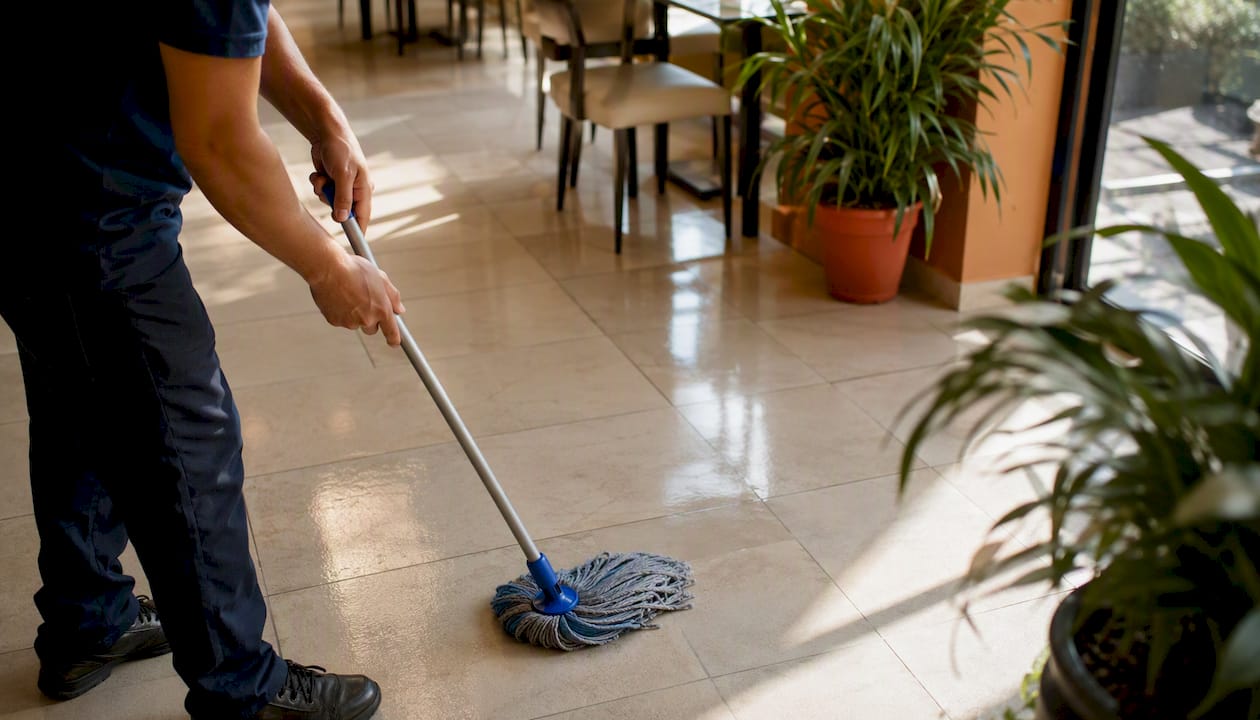
A small office under 1,500 square feet might only need a nightly crew three times a week plus one weekly deep pass. A mid-size office typically runs a nightly crew most weekdays, with weekly detail work folded into a regular visit. This creates a cadence covering core services, key task categories, and zones per visit without specifying exact numbers.
If your building needs a day porter for restroom checks or spill response during business hours, price that as its own line item, not as an assumed add-on to the nightly contract. Day porter hours run on a completely different cost structure than after-hours cleaning.
Here’s what actually determines your contract’s real cost:
| Point | Details |
|---|---|
| Frequency drives price | Nightly restroom service costs more per square foot than weekly dusting. |
| Periodics are separate | Carpet extraction and floor refinishing belong in quarterly or annual line items, not the base rate. |
| Day porter is its own line | On-demand daytime coverage should never be assumed inside a nightly contract quote. |
How Do You Measure Cleaning Quality and Performance?
A scope of work without inspection criteria is a wish list. What makes it enforceable is a measurable standard, a scheduled check, and a defined consequence when the standard isn’t met.
Start with pass/fail inspection items tied directly to your task checklist. If your SOW says “disinfect restroom fixtures,” your inspection checklist should have a line item asking “are fixtures free of visible soil and residue?” with a simple yes or no.
Build a recurring inspection schedule into the contract itself. Weekly walk-throughs by a designated site supervisor work well for most offices, with a monthly formal scorecard review between the client and vendor account manager. Document every inspection with a signed scorecard, not a verbal thumbs-up, because verbal approval evaporates the moment there’s a dispute.
Your escalation path should be spelled out in three tiers: first, a re-performance window (typically 24 to 48 hours to correct a missed task at no charge); second, a service credit for repeated failures within a billing cycle; third, a formal corrective action plan or right to terminate for chronic non-performance.
A sample inspection scorecard might include fields for area name, task inspected, pass/fail status, photo evidence field, corrective action needed, and inspector signature. Keep the tolerance language specific: “restroom floors free of standing liquid and visible debris” is measurable. “Restrooms should be clean” is not.
Facility teams that build KPI thresholds into contracts upfront tend to spend far less time arguing about subjective quality later, since the standard was agreed before anyone had a complaint to defend.
Who Provides Staffing, Equipment, and Supplies?
This section of your scope of work is where liability, consistency, and cost transparency either get locked down or left dangerously loose.
Start with staffing specifications. Define crew size relative to your square footage (a rough industry benchmark runs one cleaner per 3,000 to 4,000 square feet for standard nightly service, though restroom-heavy or high-traffic buildings need more), whether a supervisor rotates through for spot checks, and whether you’re contracting for a dedicated crew or a rotating pool. Dedicated crews tend to produce more consistent results because the same people learn your building’s quirks.
Equipment responsibility needs a clear line: does the vendor supply vacuums, floor machines, and microfiber systems, or does the client provide them for security reasons in sensitive areas like server rooms? Ladders for anything above standing reach should be spelled out explicitly, since “reachable from standing” is the natural boundary of the base scope in most contracts.
Consumables follow the same logic. Specify whether the vendor supplies paper products, hand soap, and trash liners as part of the base price or bills them separately, and set a restocking protocol so dispensers never run empty on a Monday morning.
Safety and training requirements protect both parties. Your SOW should reference vendor access to Safety Data Sheets (SDS, the modern name for what many still call MSDS) for all chemicals used on site, required personal protective equipment for tasks like floor stripping, and any training certifications the vendor’s staff hold. If your office requires green cleaning products or specific eco-certifications, name the standard explicitly rather than trusting a vague “environmentally friendly” claim. ISSA’s education resources are a solid reference point if you want to benchmark your standards against established cleaning industry practices. For SOWs that specify disinfectant use policies, it’s worth understanding how biocidal products are regulated if your organization operates under stricter compliance requirements.
Insurance language belongs in the contract too. Most commercial cleaning contracts require the vendor to carry general liability insurance and workers’ compensation coverage, with certificates provided before work begins. This isn’t a place to improvise. Talk to your legal counsel or insurance broker about the specific coverage limits appropriate for your building and industry.
How Do You Price an Office Cleaning Contract?
Pricing is where most facility managers feel lost, mostly because vendors use wildly different pricing models and it’s hard to compare apples to apples. Four methods dominate the market: flat per-visit rate, per-square-foot rate, hourly rate times crew size, and a hybrid model with add-ons priced separately for periodic services.
Per-square-foot pricing is the easiest to compare across bids, but it hides a lot of variation unless you also know the assumed task list and frequency behind that rate. A vendor quoting $0.08 per square foot monthly for a light-touch scope isn’t actually cheaper than one quoting $0.12 for a full hygiene-focused scope with nightly restroom service.
Labor minutes are the real driver behind any quote. Walk time between areas, security check-in procedures, and access logistics (elevator waits, badge systems) all eat into productive cleaning time and should factor into how a vendor calculates crew hours.
Here’s a worked example for an office suite with typical features and service levels, including nightly service on most weekdays and regular weekly deep cleaning. Labor requirements, hourly rates, monthly base costs, consumables markups, and periodic add-ons can vary widely by market and building specifics, so exact figures are not stated here.
| Cost Component | Typical Range |
|---|---|
| Nightly labor (5x/week) | $1,500 per month |
| Consumables markup | 5% of labor cost |
| Quarterly carpet extraction | $300 per visit |
| Annual floor refinishing | Priced per square foot, quoted separately |
Ask every bidder for line-item pricing, not a single bundled number. If a vendor doesn’t break out labor, consumables, and periodics separately, that’s usually a sign they’re padding one category to make another look competitive. A quote that comes in dramatically below every other bid on the exact same scope document is a red flag worth investigating before you sign, not after.
| Point | Details |
|---|---|
| Per-square-foot rates need context | Compare rates only alongside the exact task list and frequency they assume. |
| Labor minutes drive real cost | Walk time and access logistics matter as much as square footage. |
| Line-item bids reveal padding | Request separated labor, consumables, and periodic pricing from every vendor. |
What Should Be Excluded From an Office Cleaning Scope?
Scope creep kills more vendor relationships than bad cleaning ever does. The fix is boring but effective: write down what’s excluded, right alongside what’s included, and require sign-off on the exclusion list during the initial walkthrough.
Typical exclusions worth naming explicitly include moving furniture heavier than a set weight threshold, biohazard cleanup, mold remediation, pest control, and interior refrigerator cleanouts unless you’ve specifically contracted for them. These aren’t arbitrary. Most of them touch licensing or insurance boundaries that a standard janitorial contract doesn’t cover, and naming them protects both you and your vendor from liability confusion later.
Special requests and project-priced work, like event support cleanup, floor restoration, or window cleaning requiring a lift, deserve their own attachment rather than living inside the base scope. This keeps your recurring monthly invoice predictable while still giving you a documented path to request extra work when you need it.
A simple change-order process prevents most mid-contract arguments:
- Client submits a written request describing the desired change
- Vendor provides a price quote and timeline within a set number of business days
- Client approves in writing (email is fine, verbal is not)
- Vendor schedules the work and confirms completion against the original request
Attach your exclusions list as a signed exhibit during the vendor walkthrough, not as a footnote buried in the master agreement. Getting a signature on this document before service starts is the single easiest way to prevent the “but I thought that was included” conversation three months in.
Pro Tip: Require your vendor to initial each exclusion item individually during the walkthrough, not just sign one blanket page. It forces both sides to actually read the list instead of skimming past it.
Can I Use a Sample SOW Template for My Office?
Yes, and you should start from one rather than writing from scratch. A complete cleaning scope of work generally follows a predictable structure that you can adapt to your building size in under an hour.
Here’s what a full sample SOW should contain, section by section:
- Site information — address, square footage, floor plan reference, access instructions
- Service objective — a one-paragraph statement of the overall cleanliness standard expected
- Areas included — the complete room-by-room list from your scope mapping
- Detailed tasks and frequencies — your full checklist organized by daily, weekly, monthly, and periodic
- Supplies and equipment responsibilities — who provides what, restocking protocol
- QA and inspection protocol — scorecard fields, inspection frequency, escalation path
- Pricing and invoicing cadence — monthly rate, periodic add-on pricing, payment terms
- Exclusions — the signed exhibit discussed above
- Change control — the four-step process for scope changes
- Contacts and signatures — designated points of contact for both parties, with signature lines
For day-to-day operational use, a simpler one-page checklist works better than the full contract document. Vendor crews need something they can glance at nightly, not a legal document. Break it into three columns: daily tasks, weekly tasks, and monthly tasks, each with a checkbox and space for the crew lead’s initials.
| Document Type | Purpose | Who Uses It |
|---|---|---|
| Full SOW | Contract and RFP attachment | Facility manager, vendor management, legal |
| One-page checklist | Nightly operational reference | Cleaning crew, site supervisor |
| Inspection scorecard | Quality verification | Site inspector, vendor account manager |
Pro Tip: Keep a laminated copy of the one-page checklist taped inside the janitor’s closet. It sounds low-tech, but it eliminates the “I forgot what was on the list” excuse entirely.
Customizing this template for a different office type is mostly a matter of adjusting the area list and hygiene intensity. A medical office needs stricter disinfection protocols and possibly regulated waste handling. A tech company with an open floor plan and kitchen-heavy culture needs more breakroom attention and less private-office detailing. Start from the standard template, then adjust the task list weight toward whatever your specific industry actually needs.
Facility teams managing multiple locations sometimes use planning software like Aspire or Janitorial Manager to standardize these templates across sites and track completion digitally, which can be worth exploring if you’re overseeing more than a handful of properties.
How Does This Look in a Real Office Cleaning Quote?
Here’s how this whole process plays out when it moves from paper to a priced proposal. A Miami-area office manager comes to us with a 2,000 square foot suite: reception, six private offices, one conference room, a small kitchenette, and two restrooms. No existing SOW, just a vague verbal arrangement with a previous vendor that kept missing restroom restocking.
The process to convert that into a priced line-item quote runs like this:
- Gather site data — square footage by area type, current pain points (restroom restocking, in this case), and access hours
- Build the task matrix — daily restroom and high-touch service, weekly detailed dusting and glass, quarterly carpet care for the reception rug
- Assign frequencies — nightly five days a week for the base scope, quarterly for carpet extraction
- Calculate labor minutes — roughly 100 minutes per night for a two-person crew based on the layout and restroom count
- Price consumables — restroom and kitchen supplies added as a fixed monthly line, restocked to specified par levels
- Generate the quote — a single line-item proposal covering base nightly service, consumables, and the quarterly periodic charge
The estimation fields that matter most in this process are square footage, task minutes per area, crew size, monthly consumables volume, and periodic service frequency. Get those five numbers right and the quote practically writes itself.
This is exactly the kind of situation where an instant estimation tool shortens the back-and-forth dramatically. Instead of waiting days for a callback and a guessed number, a facility manager can plug in square footage and service preferences and get a real number in about 60 seconds, which removes most of the ambiguity that normally stretches a vendor selection process out for weeks.
Pro Tip: Bring your square footage and area breakdown to the first vendor conversation already written down. It cuts the quoting timeline roughly in half because nobody’s guessing at the basics.
The biggest mistake I see in office cleaning contracts
The single most common drafting mistake isn’t missing tasks. It’s vague frequency language. “Weekly dusting” tells a vendor almost nothing about which surfaces, which day, or what “dusting” actually means as a finished result. I’d rather see a shorter task list with airtight frequency and acceptance language than a sprawling checklist that leaves room for interpretation on every line.
My procurement sequencing recommendation is simple: nail down the scope document first, walk the site with each bidder second, and only request pricing third. Facility managers who ask for pricing before the scope is locked almost always end up comparing bids that aren’t actually comparable, because every vendor quietly filled in the gaps with their own assumptions.
How Limpiezatropical Can Help You Build a Contract-Ready SOW
Writing a scope of work from a blank page is the hardest part of this whole process, and it’s exactly where Limpiezatropical’s approach saves the most time compared to starting from scratch with a generic online template. Instead of guessing at square footage math or hunting down a vendor for a callback that takes days, you get a real, itemized number for your Miami office in about 60 seconds using our instant estimation tool, which reflects your actual layout and cleaning frequency rather than a rough industry average.
Limpiezatropical works with facility managers and business owners across Homestead, Kendall, Cutler Bay, South Miami, and Coral Gables to turn a rough space description into a priced, line-item proposal. We’ll walk your site, help you build out the task matrix by area, and hand you a document you can actually attach to an RFP. If your needs shift between visits, whether that’s a one-off deep clean before a client visit or a move-in cleanup for a new suite, those get scoped and priced separately from your recurring plan so your monthly number never carries surprise charges.
Our recurring cleaning plans work the same way for offices as they do for homes: consistent local team, transparent pricing, and supplies included as part of the service. Get your instant office cleaning quote today and see exactly what a properly scoped contract costs for your space.
Frequently Asked Questions About Office Cleaning Scopes of Work
What is the difference between a cleaning checklist and a scope of work? A checklist lists tasks. A scope of work adds areas, frequencies, responsibilities, and quality standards, making it a binding contract document rather than a reference sheet.
How detailed should an office cleaning SOW be for a small business? Even a 1,000 square foot office benefits from the same six-item structure, just with a shorter area list and possibly a lighter frequency matrix, such as three nights a week instead of five.
Should I include cleaning supplies in the vendor’s price or buy them separately? Most facility managers find it simpler to have the vendor supply and bill for consumables as part of the base rate, since it removes one more thing you have to track and restock yourself.
How often should office carpets get professionally cleaned? Quarterly extraction works for most standard-traffic offices, while high-traffic entryways or reception areas sometimes need it more often depending on foot traffic and local conditions.
What happens if a vendor consistently fails inspection standards? A well-written SOW includes a tiered escalation path: a re-performance window first, a service credit for repeated failures, and a formal corrective action plan or termination right for chronic issues.
Sources
- Office Cleaning Scope of Work — What to Include (Salt Lake City) | Advanced Building Care
- Commercial Office Cleaning Checklist (Daily to Quarterly) - Allied Facility Care
- How to Create a Cleaning Scope of Work for an Office (Template + Examples) - House of Stone Place
- Office Cleaning Checklist: What’s in a Scope of Work - Avanti Green Eco Cleaning